
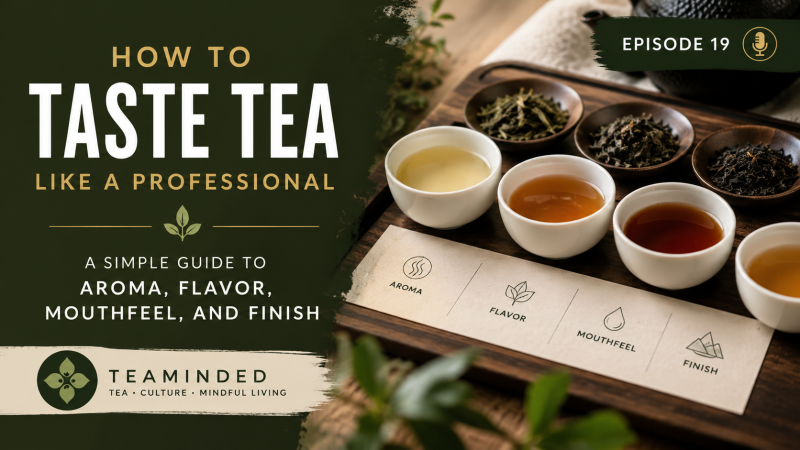
Have you ever read a tea description that mentions notes of honey, orchids, fresh grass, stone fruit, roasted nuts, or minerals and wondered how anyone could possibly taste all of that in a cup of tea?
Perhaps you’ve taken a sip of the same tea and thought:
It tastes like tea.
That’s completely normal.
Learning how to taste tea doesn’t require an extraordinary palate or years of professional training. You don’t need to memorize a complicated vocabulary or identify every flavor correctly.
You simply need to learn how to pay attention.
In this guide, we’ll explore how to taste tea more intentionally by focusing on appearance, aroma, flavor, mouthfeel, and finish. Whether you’re new to loose leaf tea or an experienced tea drinker, these simple techniques can help you discover more in every cup.
Quick Navigation
What Does It Mean to Taste Tea?
Tea tasting is the practice of observing and evaluating the sensory qualities of tea.
Professional tea tasters may use standardized methods when assessing teas for quality, consistency, or purchasing decisions. But you don’t need to approach tea with that level of formality to become a better taster.
For everyday tea drinkers, tasting tea can simply mean becoming more aware of what you’re experiencing.
You might notice:
- The appearance of the dry leaves
- The aroma before and after brewing
- The color of the brewed tea
- The flavors you recognize
- The texture of the tea in your mouth
- The sensations that remain after swallowing
The goal isn’t to find the “correct” answer.
The goal is to notice.
Start by Looking at the Dry Tea Leaves
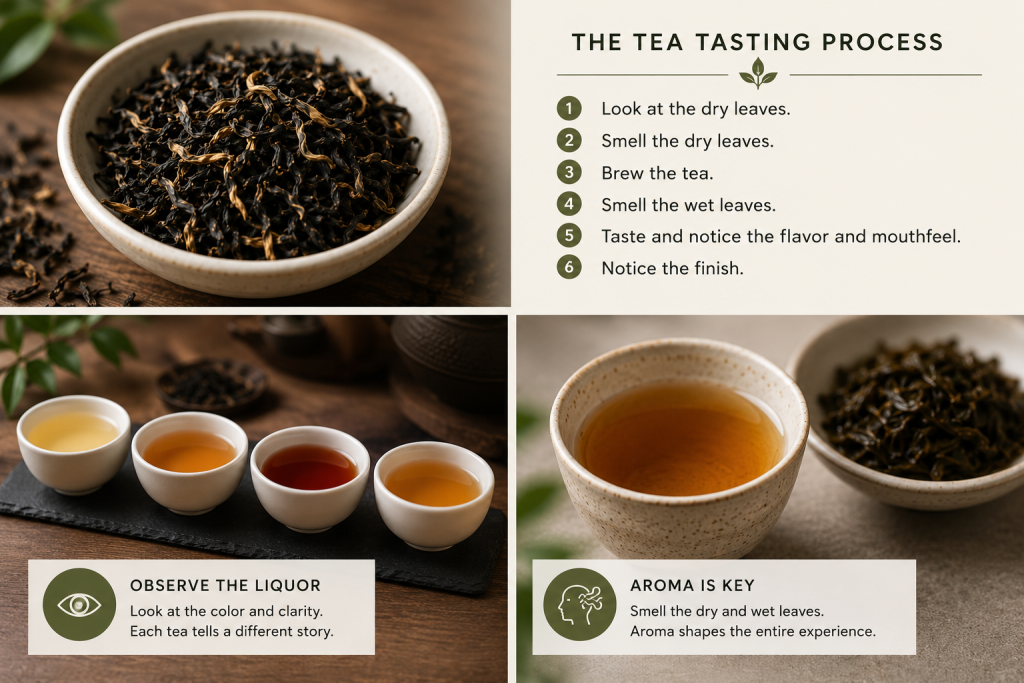
A tea tasting begins before the water ever touches the leaves.
Take a moment to look at the dry tea.
Are the leaves:
- Long and twisted?
- Small and tightly rolled?
- Flat and needle-like?
- Bright green?
- Dark brown or nearly black?
- Whole or broken?
The appearance of the leaves can offer clues about how the tea was harvested and processed.
A tightly rolled oolong looks dramatically different from a Japanese sencha. A whole leaf black tea may bear little resemblance to the smaller particles commonly found inside conventional tea bags.
Learning to observe these differences helps you develop a deeper appreciation for the craftsmanship behind loose leaf tea.
Smell the Dry Tea Leaves
Before brewing, smell the dry leaves.
Don’t immediately try to identify a specific tasting note.
Instead, ask a simpler question:
What does this remind me of?
Perhaps you notice something:
- Floral
- Grassy
- Fruity
- Woody
- Roasted
- Sweet
- Earthy
- Marine
Sometimes the aroma may remind you of a particular memory rather than a specific ingredient.
A tea might remind you of walking through a forest after rain.
A bakery.
Freshly cut grass.
The ocean.
These associations are valuable because aroma and flavor are deeply connected to memory.
Smell the Wet Tea Leaves
After brewing the tea, smell the leaves again.
This is one of the most revealing parts of the tea-tasting process.
Hot water releases aromatic compounds that may have been difficult to detect in the dry leaves. A relatively quiet tea can suddenly become intensely fragrant.
You may discover entirely new aromas.
A dry tea that smelled grassy might become sweeter after brewing.
A black tea might reveal notes of malt, dried fruit, honey, or wood.
An oolong might become intensely floral.
The wet leaves often tell a different part of the tea’s story.
Observe the Color of the Brewed Tea
Tea professionals often refer to the brewed liquid as the tea liquor.
Before taking your first sip, look at it.
What color is the tea?
It might be:
- Pale yellow
- Golden
- Bright green
- Amber
- Copper
- Deep red
- Dark brown
Also notice the clarity and brightness of the tea.
You don’t necessarily need to evaluate whether the color is “good” or “bad.” Simply observing it helps engage another sense in the tasting experience.
Tea tasting begins with attention before it moves to evaluation.
How to Taste the Flavor of Tea
Now take a sip.
One of the easiest mistakes to make is swallowing too quickly.
Instead, allow the tea to move across your mouth.
Pay attention to your first impression.
Do you notice:
- Sweetness?
- Bitterness?
- Umami?
- Floral notes?
- Fruit?
- Roasted flavors?
- Vegetal characteristics?
- Earthiness?
You don’t need sophisticated language.
If a tea reminds you of toast, peaches, seaweed, flowers, or autumn leaves, those impressions are useful.
Your tasting experience belongs to you.
There Is No Single Correct Tasting Note
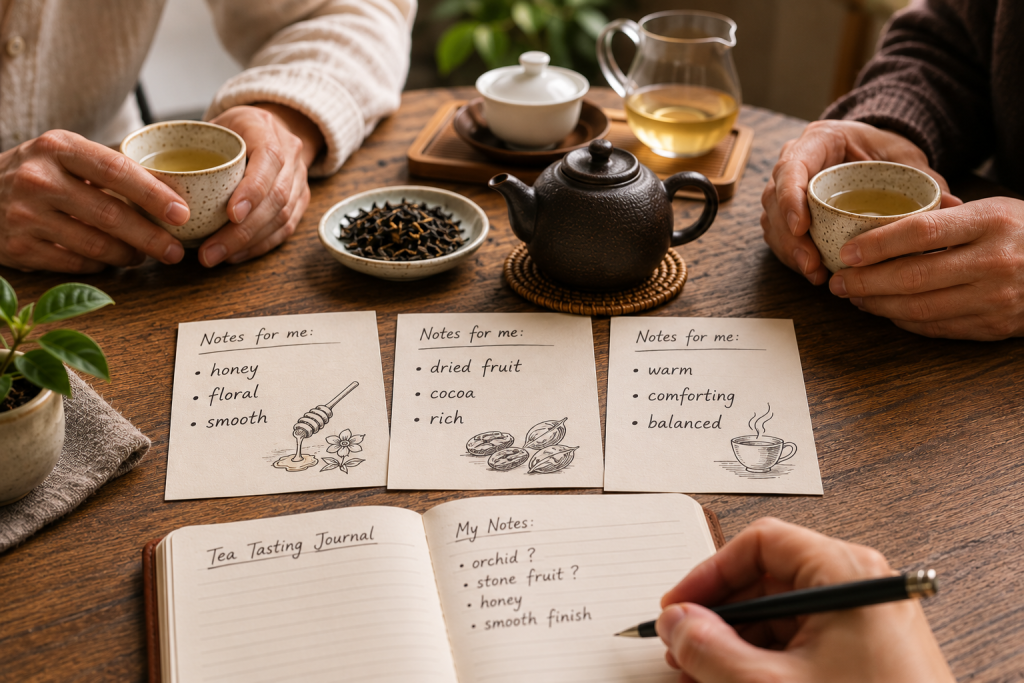
Two people can drink the same tea and describe it differently.
One person might taste honey.
Another might notice dried fruit.
Someone else might simply describe the tea as warm and comforting.
None of these observations are necessarily wrong.
Taste is influenced by:
- Memory
- Culture
- Previous experiences
- Diet
- Personal sensitivity
- The water used for brewing
- Brewing temperature and time
This is one reason tasting notes should be viewed as guides rather than answers.
A tea package may describe notes of orchid and stone fruit. If you don’t taste those exact flavors, you haven’t failed the tasting.
Notice what you experience.
What Is Mouthfeel in Tea?
One of the most overlooked aspects of tea tasting is mouthfeel.
Mouthfeel describes the physical sensation or texture of tea in your mouth.
Tea can feel:
- Light
- Thick
- Silky
- Creamy
- Brothy
- Brisk
- Dry
- Smooth
A Japanese gyokuro, for example, can have a rich, almost broth-like texture.
A delicate white tea may feel soft and light.
A strong black tea may create a noticeable drying sensation.
Learning to notice texture can dramatically expand the way you experience tea.
Bitterness vs. Astringency: What’s the Difference?
Bitterness and astringency are often confused, but they aren’t the same thing.
Bitterness is a flavor.
Astringency is a physical sensation.
Astringency creates a drying or puckering feeling in the mouth, similar to the sensation produced by strong red wine or an underripe fruit.
Some astringency can contribute structure and liveliness to a tea.
Excessive bitterness or astringency, however, may indicate that a tea was brewed too hot or steeped too long.
If you’re struggling with bitter tea, experimenting with water temperature can make a significant difference. Read our guide to How Water Changes the Taste of Tea to learn more about the relationship between water and extraction.
Pay Attention to the Finish
The tea-tasting experience doesn’t end when you swallow.
What happens afterward?
This is known as the finish or aftertaste.
Ask yourself:
- Does the flavor disappear quickly?
- Does sweetness remain?
- Is there a floral aroma?
- Do you notice a cooling sensation?
- Does the tea leave a gentle dryness?
- Does the flavor continue to evolve?
Some of the most memorable teas have long, complex finishes that continue changing after the sip is over.
A lingering finish is often one of the qualities tea enthusiasts appreciate in premium loose leaf tea.
Taste Tea Across Multiple Infusions
Many high-quality loose leaf teas can be brewed more than once.
And each infusion may taste different.
The first infusion might be:
Light.
Aromatic.
Delicate.
The second may become:
Richer.
Sweeter.
More complex.
A third infusion may reveal entirely new characteristics.
This is one of the pleasures of loose leaf tea.
A single tea can unfold gradually over time.
If you’re wondering why premium tea often costs more, the ability to enjoy multiple infusions is one factor worth considering. Learn more in Why Loose Leaf Tea Costs More (And Why Many Tea Drinkers Think It’s Worth It).
A Simple Tea Tasting Exercise to Try at Home
You don’t need professional equipment to practice tea tasting.
Choose one loose leaf tea you already enjoy and give yourself ten quiet minutes.
Then follow these steps:
- Look at the dry leaves. Notice their shape, size, and color.
- Smell the dry leaves. Ask what the aroma reminds you of.
- Brew the tea carefully. Use an appropriate water temperature and steeping time.
- Smell the wet leaves. Notice how the aroma has changed.
- Observe the brewed tea. Look at its color and clarity.
- Take a slow sip. Notice the first flavors that appear.
- Pay attention to mouthfeel. Is the tea light, creamy, silky, brisk, or drying?
- Notice the finish. What remains after you swallow?
- Brew another infusion. See how the tea changes.
You may want to write down a few words.
Not a formal review.
Just impressions.
Sweet. Grassy. Floral. Warm. Bright. Silky. Comforting.
Over time, you’ll naturally develop your own tea vocabulary.
Do You Need a Tea Tasting Journal?
A tea journal isn’t necessary, but it can be useful.
Recording a few basic details can help you recognize patterns in the teas you enjoy.
Consider noting:
- Tea name
- Tea type
- Origin
- Water temperature
- Steeping time
- Aroma
- Flavor
- Mouthfeel
- Finish
- Overall impression
After tasting dozens of teas, you may discover that you’re consistently drawn to certain characteristics.
Perhaps you prefer roasted oolongs.
Fresh Japanese green teas.
Malty black teas.
Or delicate floral teas.
A tasting journal can help turn those preferences into knowledge.
How to Improve Your Tea-Tasting Skills
The best way to improve your palate is simply to taste more tea.
But comparison can accelerate the process.
Try tasting:
- Two green teas side by side
- Sencha and matcha
- Assam and Darjeeling
- A tea bag and a whole leaf tea
- The same tea brewed at two temperatures
- The same tea using two different types of water
Side-by-side comparisons make subtle differences easier to recognize.
You may be surprised by how quickly your palate develops when you begin paying closer attention.
Tea Tasting Is Really About Attention
Learning to taste tea isn’t really about becoming a professional.
It’s about becoming more present.
We spend much of our lives moving quickly.
Eating while working.
Drinking while driving.
Looking at one screen while another plays in the background.
Tea offers something different.
It invites us to stop.
To taste.
To notice.
The more attention we give to a cup of tea, the more the tea seems to reveal.
The differences were always there.
We simply learned how to notice them.
Final Thoughts
You don’t need an extraordinary palate to become better at tasting tea.
You don’t need expensive equipment.
And you don’t need to impress anyone with elaborate tasting notes.
You simply need curiosity.
The next time you make tea, give it your full attention for a few minutes.
Notice the leaves.
The aroma.
The color.
The flavor.
The mouthfeel.
The finish.
You may discover that a cup you’ve enjoyed many times has been saying much more than you realized.
You just needed to listen.
Frequently Asked Questions
How do you taste tea properly?
Start by observing the dry leaves and smelling their aroma. After brewing, smell the wet leaves, observe the color of the tea, and take a slow sip. Pay attention to flavor, mouthfeel, astringency, and the finish.
What are the main elements of tea tasting?
The main elements include appearance, aroma, flavor, mouthfeel, and finish. Professional tasting may involve additional standardized evaluation criteria.
What does mouthfeel mean in tea?
Mouthfeel describes the physical texture and sensation of tea in the mouth. Tea may feel light, thick, creamy, silky, brisk, brothy, or drying.
What is the difference between bitterness and astringency in tea?
Bitterness is a flavor, while astringency is a drying or puckering physical sensation in the mouth.
How can I improve my tea-tasting skills?
Taste tea regularly, pay close attention to each cup, keep simple tasting notes, and compare different teas side by side.
Do I need special equipment to taste tea?
No. A cup or teapot, good water, and quality tea are enough to begin developing your tea-tasting skills.
Listen to the TeaMinded Podcast
This article accompanies Episode 19 of the TeaMinded Podcast: How to Taste Tea Like a Professional.
TeaMinded explores tea culture, loose leaf tea, Japanese tea, tea rituals, craftsmanship, mindfulness, and intentional living through the lens of tea.
Listen on Spotify and YouTube, and continue exploring the world of tea at TeaMinded.
Related TeaMinded Articles
- Why Loose Leaf Tea Costs More (And Why Many Tea Drinkers Think It’s Worth It)
- How Water Changes the Taste of Tea
- The Six Types of Tea Explained
- The Craftsmanship Behind a Good Cup of Loose Leaf Tea
- The Complete Guide to Sencha Tea
- Tea Bags vs Loose Leaf Tea

Scott is the founder of TeaMinded. He enjoys tasting and discovering teas from across the globe, with green teas and ceremonial matcha from Japan being among his favorites. He’s grateful to be immersed in the tea community, always learning and sharing along the journey.