
Quick Navigation
Understanding the Six Great Families of Tea
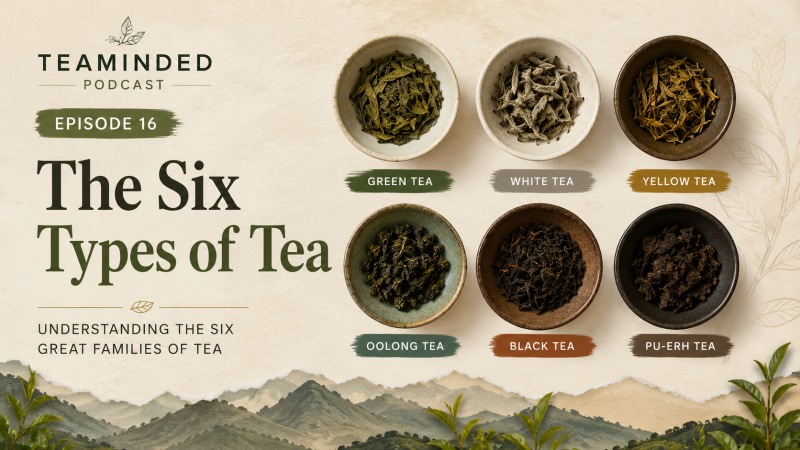
TeaMinded Podcast Episode 16
Many people assume that green tea, black tea, oolong tea, and white tea come from different plants.
It’s a reasonable assumption.
After all, they look different, smell different, and taste dramatically different.
But one of the most fascinating facts in tea culture is that all true tea comes from the same plant:
Camellia sinensis.
In Episode 16 of the TeaMinded Podcast, we explore the six types of tea and explain how a single plant can produce such a remarkable range of flavors, aromas, and experiences.
Understanding the six major tea categories provides a foundation for nearly everything else in tea. Whether you’re new to loose leaf tea or simply looking to deepen your appreciation for tea culture, learning these six categories will help you navigate the world of tea with confidence.
The six types of tea are:
- Green Tea
- White Tea
- Yellow Tea
- Oolong Tea
- Black Tea
- Pu-erh Tea
The differences between them come not from the plant itself, but from how the leaves are harvested, processed, oxidized, aged, and crafted.
Green Tea
Green tea is one of the most widely consumed tea categories in the world.
After harvest, the leaves are heated quickly to prevent oxidation. This helps preserve their fresh character and vibrant green color.
Green teas can range from grassy and vegetal to sweet, nutty, marine, or richly umami.
Popular examples include:
- Sencha
- Matcha
- Gyokuro
- Long Jing (Dragon Well)
Green tea often offers the closest expression of the freshly harvested leaf.
White Tea
White tea is among the least processed of all tea categories.
The leaves are typically harvested, withered, and dried with minimal intervention.
This gentle approach often produces teas that are delicate, nuanced, and surprisingly complex.
Common flavor notes include:
- Honey
- Melon
- Wildflowers
- Hay
- Soft fruit
Popular examples include Silver Needle and White Peony.
Yellow Tea
Yellow tea is one of the rarest tea categories.
Produced primarily in China, yellow tea undergoes an additional processing step called “sealed yellowing.”
This process softens some of the grassy qualities found in green tea and creates a smoother, rounder cup.
Although less common than other tea styles, yellow tea is prized for its elegance and subtle sweetness.
Oolong Tea
Oolong tea occupies the broad territory between green tea and black tea.
Depending on the style, oolong teas may be lightly oxidized or heavily oxidized.
As a result, oolong is often considered the most diverse category of tea.
Flavor profiles can include:
- Floral
- Creamy
- Fruity
- Roasted
- Mineral
- Honey-like
Famous examples include:
- Tie Guan Yin
- Da Hong Pao
- Alishan Oolong
Many tea enthusiasts spend years exploring the vast world of oolong tea alone.
Black Tea
Black tea undergoes full oxidation, producing darker leaves and deeper flavors.
It is the tea category most familiar to many Western tea drinkers.
Black teas often feature notes of:
- Malt
- Chocolate
- Dried fruit
- Spice
- Honey
- Caramel
Popular examples include:
- Assam
- Darjeeling
- Ceylon
- Keemun
- English Breakfast
Black tea provides a wonderful introduction to specialty tea because of its bold and approachable character.
Pu-erh Tea
Pu-erh tea is perhaps the most unique of the six categories.
Originating in China’s Yunnan Province, pu-erh undergoes fermentation and aging processes that continue developing flavor over time.
Some pu-erh teas are aged for years.
Others for decades.
Flavor profiles can include:
- Earthy
- Woody
- Sweet
- Mineral
- Rich and smooth
For many tea drinkers, pu-erh becomes a lifelong area of exploration.
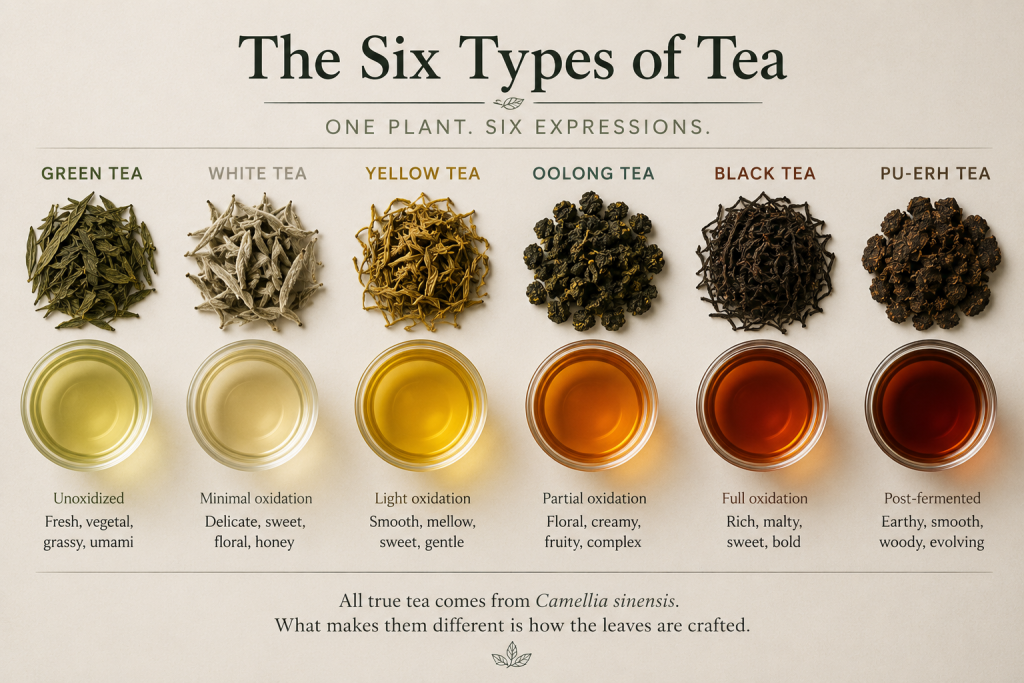
The six major tea categories (green, white, yellow, oolong, black, and pu-erh) may look and taste dramatically different, but they all originate from the same plant: Camellia sinensis. What makes each tea unique is the craftsmanship behind how the leaves are harvested, processed, oxidized, and aged.
Why Understanding the Six Types of Tea Matters
One of the most important lessons in tea is that the six types of tea are not six different plants.
They are six different expressions of the same leaf.
The differences emerge through craftsmanship.
How the leaves are harvested.
How they are processed.
How they are oxidized.
How they are aged.
Understanding these categories makes it easier to explore tea intentionally and discover which styles resonate most with your personal preferences.
If you’re just beginning your journey, our articles on A Beginner’s Guide to Loose Leaf Tea and The Craftsmanship Behind a Good Cup of Loose Leaf Tea provide excellent next steps.
In This Episode
- What the six types of tea are
- Why all tea comes from the same plant
- Green tea explained
- White tea explained
- Yellow tea explained
- Oolong tea explained
- Black tea explained
- Pu-erh tea explained
- Tea oxidation and processing
- How craftsmanship shapes flavor
Listen on Spotify
Watch the Episode
Frequently Asked Questions
What are the six types of tea?
The six major tea categories are green tea, white tea, yellow tea, oolong tea, black tea, and pu-erh tea.
Do all teas come from the same plant?
Yes. All true tea comes from the Camellia sinensis plant. Differences come from how the leaves are processed, oxidized, and aged.
What is the difference between green tea and black tea?
Green tea is minimally oxidized, while black tea is fully oxidized. This gives black tea a darker color, deeper flavor, and richer aroma.
Which type of tea is best for beginners?
Many beginners start with green tea, black tea, or lightly oxidized oolong tea because they are easy to find and approachable.
About TeaMinded
TeaMinded explores tea culture, loose leaf tea, tea rituals, Japanese tea, mindfulness, craftsmanship, creativity, and intentional living through educational episodes, tea reviews, reflections, and conversations.
Whether you’re just beginning your tea journey or deepening a lifelong appreciation for tea, TeaMinded helps uncover the stories, traditions, and craftsmanship behind every cup.
#TeaPodcast #TeaCulture #LooseLeafTea #GreenTea #BlackTea #OolongTea #WhiteTea #PuErhTea #TeaEducation #TeaMinded

Scott is the founder of TeaMinded. He enjoys tasting and discovering teas from across the globe, with green teas and ceremonial matcha from Japan being among his favorites. He’s grateful to be immersed in the tea community, always learning and sharing along the journey.