
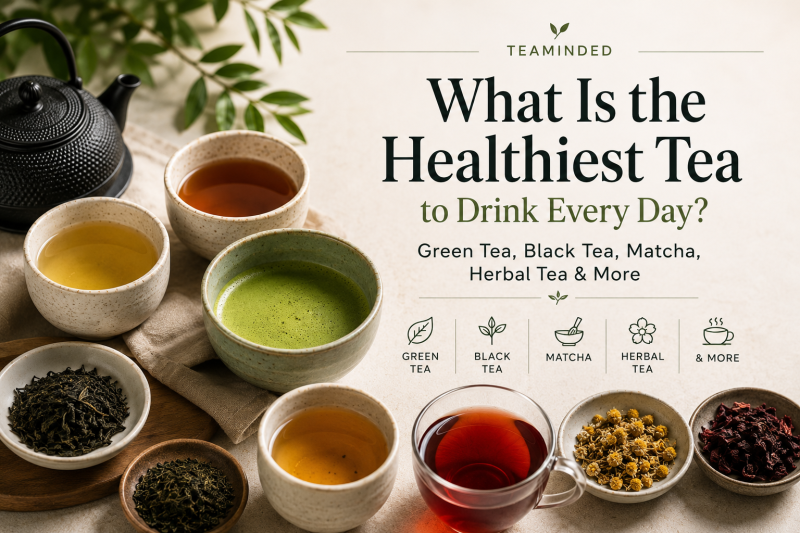
If you’re trying to make tea part of a healthier daily routine, one question naturally comes up: What is the healthiest tea to drink every day?
Green tea usually receives the most attention. Matcha has developed its own reputation as a wellness drink. Black tea remains one of the most widely consumed teas in the world, while white tea, oolong, and herbal teas each offer their own characteristics.
So which tea should you actually drink?
The answer is more interesting than simply declaring one tea the winner.
Different teas contain different naturally occurring compounds, caffeine levels can vary considerably, and the way you prepare your tea matters. Just as importantly, the best everyday tea may be one you genuinely enjoy enough to drink consistently.
In this guide, we’ll look at green tea, matcha, black tea, white tea, oolong, and herbal tea to help you decide which might fit best into your daily routine.
Quick answer: There isn’t one universally healthiest tea. Green tea is particularly well studied and is a strong everyday choice, but black, white, and oolong teas also contain beneficial plant compounds. Matcha offers a more concentrated form of green tea, while many herbal teas provide caffeine-free alternatives. The best choice depends on your preferences, caffeine sensitivity, overall diet, and individual health needs.
Quick Navigation
Is There Really a Healthiest Tea?
Probably not in the way the question is usually presented.
Tea is not medicine, and no particular variety should be treated as a shortcut to good health.
Instead, tea can be one part of a larger healthy lifestyle that includes good nutrition, regular movement, adequate sleep, hydration, and other healthy habits.
That said, tea is an interesting beverage from a nutritional perspective.
Traditional teas—including green, black, white, oolong, and pu-erh—all originate from the same plant:
Camellia sinensis.
The enormous differences between these teas come largely from factors such as:
- Cultivar
- Growing region
- Climate
- Harvest season
- Which leaves are picked
- Processing
- Oxidation
- Roasting
- Storage
- Brewing
These differences influence both what ends up in your cup and what the tea tastes like.
And that’s one reason choosing a daily tea shouldn’t be based solely on a list of potential health benefits.
Flavor matters too.
Green Tea: The Classic Healthy Tea
If you asked most people to name the healthiest tea, green tea would probably be the most common answer.
There is good reason for its reputation.
Green tea contains naturally occurring plant compounds called polyphenols, including a group known as catechins.
One of the most widely studied tea catechins is epigallocatechin gallate, better known as EGCG.
Researchers continue to study green tea and its compounds in relation to a variety of health outcomes.
The National Center for Complementary and Integrative Health’s overview of green tea research provides a useful summary of the current evidence, including what researchers know—and what remains uncertain.
But green tea is not a single beverage.
There is an enormous world within the category.
Japanese green teas include:
- Sencha
- Gyokuro
- Genmaicha
- Hojicha
- Bancha
China produces its own extraordinary range of green teas, including styles such as Dragon Well, also known as Longjing.
Each has its own flavor, aroma, caffeine level, and brewing requirements.
A Japanese sencha might be vegetal, grassy, fresh, or rich in umami.
A Chinese green tea might be softer, sweeter, or more nutty.
If you’re interested in exploring Japanese green tea more deeply, read TeaMinded’s Complete Guide to Sencha Tea.
Is green tea good to drink every day?
For many people, unsweetened green tea can fit comfortably into a daily routine.
But there is an important qualification.
You should actually enjoy it.
If you’re forcing yourself to drink green tea purely because you’ve heard it’s healthy, explore different varieties before deciding green tea isn’t for you.
The difference between two green teas can be remarkable.
Matcha: A More Concentrated Green Tea Experience
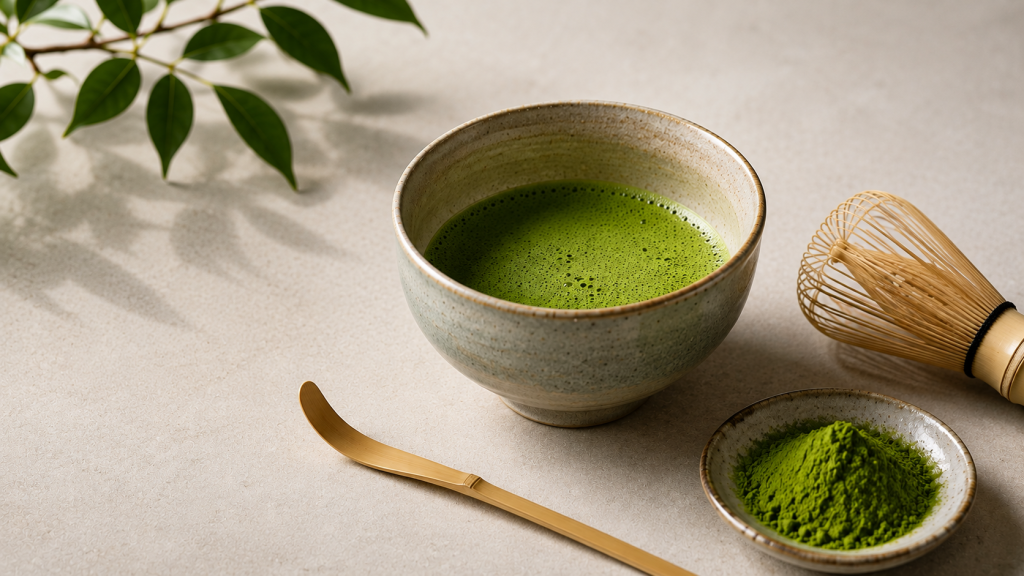
Matcha is green tea, but the way we consume it is different.
With conventional loose leaf tea, you steep leaves in water and then remove them.
With matcha, specially grown and processed tea leaves are ground into an extremely fine powder. That powder is whisked into water and consumed.
In other words, you’re consuming the powdered tea leaf itself.
That is one reason matcha receives so much attention.
Matcha contains naturally occurring tea compounds, including polyphenols, caffeine, and the amino acid L-theanine.
It can also contain more caffeine per serving than many traditionally brewed green teas, depending on how much matcha you use.
Is matcha healthier than green tea?
This isn’t as straightforward as it might seem.
Matcha provides a different and potentially more concentrated tea experience because you’re consuming the leaf rather than simply drinking an infusion.
But that doesn’t automatically mean everyone should replace conventional green tea with matcha.
Matcha can also provide more caffeine.
And quality matters.
Good matcha should have a vibrant appearance, fine texture, fresh aroma, and balanced flavor rather than simply tasting aggressively bitter.
For some people, matcha makes an excellent morning beverage or alternative to coffee.
For others, a lightly brewed sencha may be a better everyday choice.
The important point is that matcha and traditional green tea don’t need to compete.
You can enjoy both.
Black Tea: Healthier Than Its Reputation Suggests
Black tea sometimes gets overlooked when conversations turn toward healthy tea.
That’s unfortunate.
Black tea comes from the same Camellia sinensis plant as green tea.
The primary difference is processing.
During the production of black tea, the leaves undergo substantially more oxidation. This transforms both the flavor of the tea and some of its naturally occurring compounds.
Black tea contains polyphenols, including compounds known as theaflavins and thearubigins.
It also tends to produce a richer and more robust cup.
Depending on its origin and style, black tea may taste:
- Malty
- Fruity
- Honey-like
- Floral
- Brisk
- Rich
- Spicy
Famous black teas include Assam, Darjeeling, Ceylon teas, Keemun, and many others.
Can you drink black tea every day?
For many tea drinkers, absolutely.
An unsweetened black tea can be a particularly practical everyday beverage for someone who prefers stronger flavors.
It can also be a useful alternative to heavily sweetened coffee drinks, sodas, or energy drinks.
Sometimes the benefit of choosing tea isn’t simply what you’re adding to your diet.
It’s what the tea replaces.
White Tea: Delicate and Minimally Processed
White tea is often described as one of the least processed traditional tea categories.
It is generally produced from young buds and leaves that undergo relatively minimal processing before drying.
That simplicity can produce wonderfully delicate teas.
Depending on the tea, you may encounter flavors that are:
Sweet.
Floral.
Melon-like.
Honeyed.
Soft.
Subtle.
White tea also contains naturally occurring polyphenols and caffeine.
However, don’t assume that white tea is automatically caffeine-free or even extremely low in caffeine.
Caffeine levels in tea are more complicated than the color of the finished tea suggests.
The particular leaves, cultivar, harvest, brewing method, and amount of tea used can all influence how much caffeine ends up in your cup.
Oolong: One of Tea’s Most Diverse Categories
If you haven’t explored oolong tea, you’re missing one of the most fascinating categories in the tea world.
Oolong is partially oxidized, placing it somewhere between green and black tea in the broadest sense.
But that description barely captures its diversity.
Some oolongs are remarkably light and floral.
Others are deeply roasted.
You may encounter flavors reminiscent of:
Orchids.
Stone fruit.
Cream.
Honey.
Minerals.
Roasted nuts.
Caramel.
[pause]
One of the pleasures of high-quality oolong is that many varieties can be steeped multiple times.
The same leaves may reveal different aromas and flavors with each infusion.
For someone who wants tea to be more than simply a source of caffeine, oolong can become a wonderful daily ritual.
Herbal Tea: A Caffeine-Free Alternative
Technically, most herbal teas aren’t actually tea.
True tea comes from Camellia sinensis.
Chamomile, peppermint, rooibos, hibiscus, ginger, and other herbal beverages are more accurately described as herbal infusions or tisanes.
But they’re commonly called tea, and they can play an important role in a daily tea routine.
Popular options include:
- Chamomile
- Peppermint
- Rooibos
- Hibiscus
- Ginger
- Lemon balm
One of their biggest advantages is simple:
Many herbal teas are naturally caffeine-free.
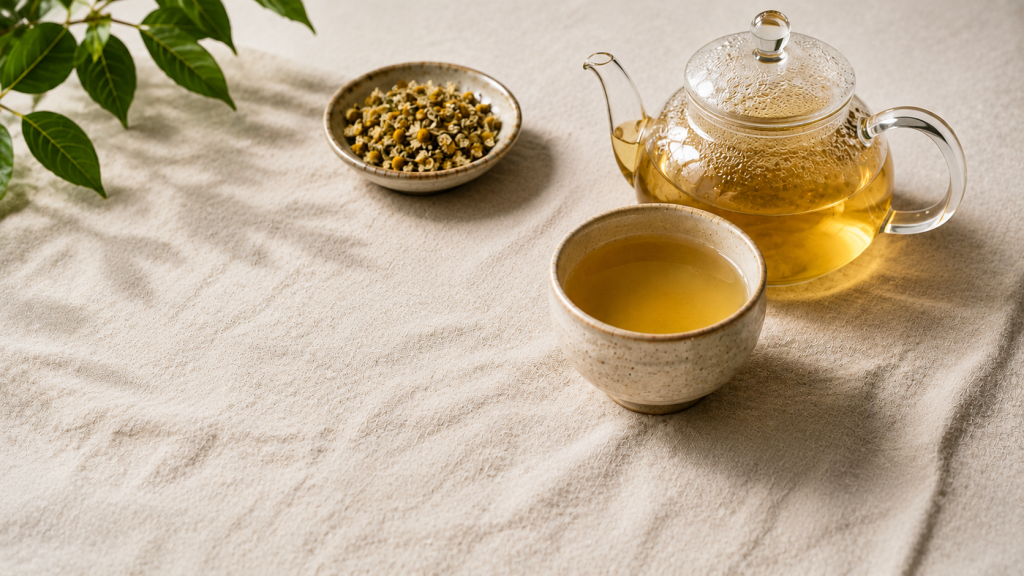
That makes them particularly appealing later in the day.
You might drink matcha in the morning, sencha with lunch, and an herbal infusion in the evening.
Different teas can serve different moments.
Important: “Herbal” doesn’t automatically mean appropriate for everyone. Individual herbs can interact with medications or may not be appropriate during pregnancy or with certain medical conditions.
Which Tea Has the Most Caffeine?
Caffeine levels in tea are surprisingly difficult to predict from tea type alone.
You may have heard simple rules such as:
Black tea has the most caffeine.
Green tea has less.
White tea has almost none.
The reality is considerably more complicated.
The amount of caffeine in your cup can be influenced by:
- Tea cultivar
- Growing conditions
- Leaf age
- Harvesting
- Processing
- Amount of tea used
- Water temperature
- Steeping time
- Brewing method
Matcha can provide a relatively substantial amount of caffeine because you’re consuming powdered tea leaf.
But even within a single category, caffeine levels can vary.
This is why someone who is particularly sensitive to caffeine should pay attention not only to what tea they’re drinking, but also to how much, how strongly, and when they’re drinking it.
Tea, Caffeine, and L-Theanine
One reason tea can feel different from coffee is the presence of L-theanine.
L-theanine is an amino acid naturally found in tea.
Tea also contains caffeine.
The combination has attracted considerable research interest, particularly in relation to attention and cognitive performance.
Many tea drinkers describe their subjective experience of tea as being:
Alert, but calm.
Or:
Focused without feeling overly stimulated.
That doesn’t mean everyone will experience tea in exactly the same way.
Caffeine sensitivity varies considerably.
If tea interferes with your sleep, causes unwanted symptoms, or simply makes you feel uncomfortable, reducing your intake or moving caffeinated tea earlier in the day may make sense.
The Healthiest Tea May Depend on the Time of Day
Instead of choosing one tea and declaring it the healthiest, consider building a tea routine around different moments.
Morning
Matcha or black tea
These can provide a stronger tea experience and may appeal to people looking for a morning caffeine ritual.
Midmorning
Green tea
Sencha or another green tea can provide a fresh, lighter cup.
Afternoon
Oolong
Multiple infusions can turn afternoon tea into a welcome pause during the workday.
Evening
Caffeine-free herbal tea
Chamomile, rooibos, or another caffeine-free infusion can provide the ritual of tea without adding caffeine late in the day.
You certainly don’t need to drink all four.
The point is simply that different teas can fit different moments of your life.
How You Drink Your Tea Matters
There is another factor that sometimes gets lost when discussing the healthiest tea.
What are you putting in it?
A simple cup of tea might contain little more than:
Tea leaves.
Water.
That’s one of the great virtues of tea.
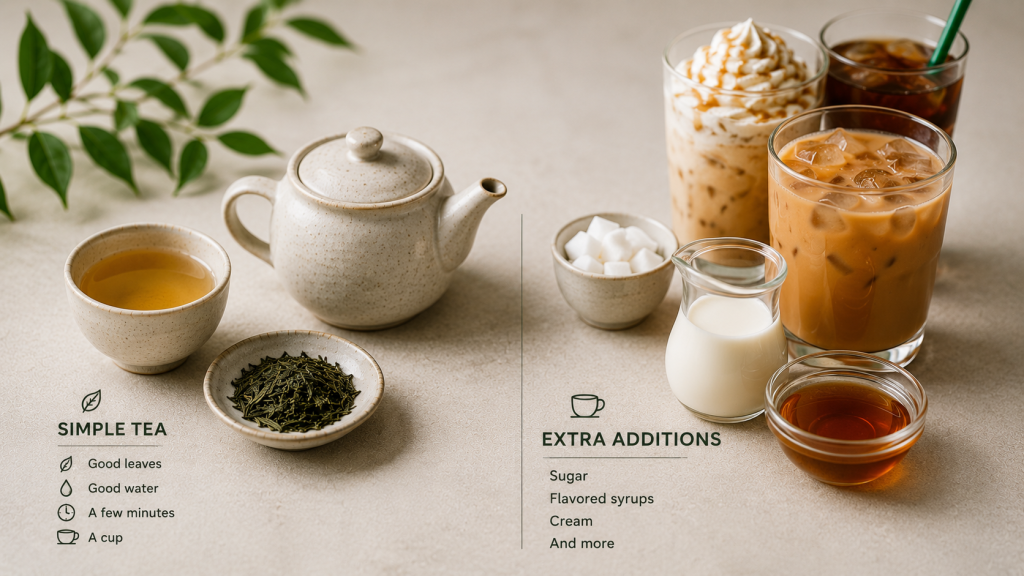
But tea can also become a vehicle for large amounts of sugar, flavored syrups, cream, and other additions.
There’s nothing wrong with occasionally enjoying a sweetened tea beverage.
But if health is the primary goal, regularly drinking unsweetened or lightly prepared tea is a very different habit from consuming heavily sweetened bottled teas or café drinks.
Sometimes simplicity is useful.
Good leaves.
Good water.
A few minutes.
A cup.
Tea Is More Than Its Nutritional Profile
There is another potential benefit of drinking tea every day that doesn’t fit neatly on a nutrition label.
The pause.
At TeaMinded, we’re interested not only in tea itself but also in what happens around the cup.
Making tea requires a small amount of time.
You heat the water.
Measure the leaves.
Wait for them to steep.
Pour the tea.
And drink.
Those few minutes can become a marker in the day.
Perhaps tea is what you make before beginning work.
Perhaps it accompanies a book in the afternoon.
Perhaps it’s your excuse to walk away from a screen for ten minutes.
Perhaps an herbal infusion signals that the day is winding down.
The tea matters.
But so does the ritual.
So, What Is the Healthiest Tea to Drink Every Day?
If you want the simplest answer, green tea is one of the strongest candidates because it has been extensively studied and provides naturally occurring polyphenols including catechins.
But that doesn’t make other teas unhealthy.
A better way to think about your options might be:
Green tea: An excellent all-around everyday tea with an extensive body of research behind it.
Matcha: A more concentrated green tea experience that also tends to provide more caffeine.
Black tea: A robust everyday choice containing its own distinctive polyphenols.
White tea: A delicate traditional tea with minimal processing and naturally occurring plant compounds.
Oolong: An exceptionally diverse category that combines flavor complexity with a wonderful brewing ritual.
Herbal tea: A broad category of caffeine-free options particularly useful later in the day.
The right answer may be more than one.
The Best Tea Is the One You’ll Actually Drink
There is little benefit in forcing yourself to drink a tea you dislike simply because someone online declared it the healthiest.
Tea is too diverse for that.
Explore.
Try sencha.
Try matcha.
Try Darjeeling.
Try an oolong.
Try white tea.
Try rooibos.
Pay attention to what you enjoy.
Notice how caffeine affects you.
Experiment with brewing temperatures and steeping times.
Even the water you use can dramatically change the final cup, as we explore in How Water Changes the Taste of Tea
And discover which teas naturally fit into your life.
If you’re new to tasting tea intentionally, read our guide to How to Taste Tea Like a Professional to learn how to recognize aroma, flavor, mouthfeel, astringency, and finish.
You may discover that your favorite tea changes as your palate develops.
That’s part of the experience.
Frequently Asked Questions
What is the healthiest tea to drink every day?
There isn’t one universally healthiest tea. Green tea is particularly well studied and contains catechins including EGCG, making it a popular everyday choice. Black, white, and oolong teas also contain naturally occurring polyphenols, while many herbal teas provide caffeine-free alternatives.
Is green tea healthier than black tea?
Green and black tea come from the same plant but are processed differently and contain different profiles of naturally occurring compounds. Rather than viewing one as universally healthier, both can be part of a balanced diet.
Is matcha healthier than regular green tea?
Matcha differs because the powdered tea leaf itself is consumed rather than simply steeped and removed. This can provide a more concentrated tea experience, but matcha can also contain more caffeine depending on the serving.
Can I drink tea every day?
For many adults, moderate tea consumption can be part of a healthy diet. Individual caffeine tolerance, medications, health conditions, pregnancy, and other factors can influence what amount or type of tea is appropriate.
What tea should I drink instead of coffee?
Black tea and matcha are popular choices for people looking for alternatives to coffee because they provide caffeine while offering a different flavor and drinking experience.
What is the best caffeine-free tea?
Many herbal infusions are naturally caffeine-free, including chamomile, peppermint, and rooibos. The best choice depends largely on your flavor preferences and individual health considerations.
Is herbal tea healthier than green tea?
They’re very different beverages. Green tea comes from Camellia sinensis and naturally contains caffeine, catechins, and L-theanine. Herbal teas come from many different plants and have properties specific to their ingredients.
Final Thoughts
Perhaps the question isn’t simply:
What is the healthiest tea?
Maybe it’s:
What tea can I enjoy consistently as part of a healthy life?
For you, that might be sencha.
Matcha.
Black tea.
Oolong.
White tea.
Or a rotation of several different teas throughout the week.
Tea doesn’t need to become another thing to optimize.
Find a few good teas you love.
Learn how to brew them well.
Take a few minutes to enjoy them.
And allow tea to become one small part of a healthier—and perhaps slightly more intentional—daily life.
Listen to TeaMinded Episode 21
This article accompanies TeaMinded Podcast Episode 21: What Is the Healthiest Tea to Drink Every Day?
In the episode, we explore green tea, matcha, black tea, white tea, oolong, and herbal tea—and why finding the right everyday tea may be more useful than searching for one universally “healthiest” cup.
TeaMinded explores tea culture, loose leaf tea, Japanese tea, craftsmanship, tea rituals, mindfulness, and intentional living through the lens of tea.
Put the kettle on, find the tea that works for you, and stay TeaMinded.

Scott is the founder of TeaMinded. He enjoys tasting and discovering teas from across the globe, with green teas and ceremonial matcha from Japan being among his favorites. He’s grateful to be immersed in the tea community, always learning and sharing along the journey.