
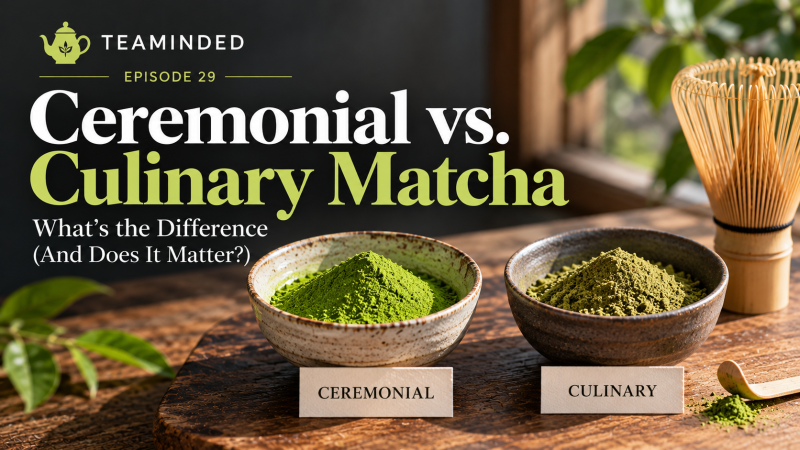
What is ceremonial-grade matcha, how does it compare with culinary-grade matcha, and is premium Japanese matcha really worth the extra money?
If you’ve ever shopped for matcha, you’ve probably noticed something confusing.
One tin is labeled ceremonial grade. Another says culinary grade. A third promises premium ceremonial matcha, while a fourth simply identifies its growing region, cultivar, and producer.
The prices can be dramatically different.
A small tin might cost $20, while another of similar size costs $50 or considerably more.
So what’s the difference?
Is ceremonial-grade matcha actually better? Does culinary grade mean inferior tea? And should you spend more for matcha you’re planning to use in a latte?
The answers are more interesting—and more nuanced—than the labels suggest.
The most important thing to understand is that ceremonial grade isn’t an officially standardized Japanese grading designation. It’s a commercial term commonly used to describe matcha intended for drinking with water, but the label alone doesn’t guarantee quality.
To understand what makes matcha exceptional, we need to look beyond the packaging and explore how it’s grown, harvested, processed, prepared, and enjoyed.
Quick Navigation
What Is Ceremonial-Grade Matcha?
Ceremonial-grade matcha generally refers to matcha marketed for traditional preparation: whisking finely ground green tea with water and drinking it without milk, sugar, or other ingredients.
Because the matcha is consumed on its own, its flavor is particularly important.
A well-made matcha intended for this purpose may offer:
- Natural sweetness and a smooth, balanced flavor
- Rich umami and pleasant vegetal characteristics
- A fresh, appealing aroma
- Fine texture and a vibrant green appearance
- Bitterness and astringency that complement rather than overwhelm the tea
However, there is an important qualification.
Japan does not have one universal, government-regulated grading system that determines which matcha qualifies as ceremonial grade.
Different producers and retailers may apply the term differently. One company’s ceremonial matcha may be another company’s everyday drinking matcha.
This doesn’t make the term meaningless. It can provide a useful indication of intended use.
But it shouldn’t be treated as an independent certification of quality.
What Is Culinary-Grade Matcha?
Culinary-grade matcha is generally marketed for use in recipes and beverages that combine matcha with other ingredients.
Common uses include matcha lattes, smoothies, baked goods, ice cream, desserts, and sauces.
In these preparations, matcha needs to maintain its identity alongside milk, sugar, flour, chocolate, or other flavors.
That often makes a stronger, more assertive flavor desirable.
Culinary matcha may have more noticeable bitterness, astringency, or robust vegetal characteristics. Those qualities can be useful in a sweetened latte or dessert.
But culinary grade doesn’t automatically mean poor quality.
A carefully produced culinary matcha can be excellent for its intended purpose.
In fact, an expensive, delicate matcha might be less satisfying in a latte than a more affordable matcha with enough character to remain noticeable through the milk.
The best matcha depends on how you plan to drink it.
Ceremonial vs. Culinary Matcha: Key Differences
| Characteristic | Ceremonial-grade matcha | Culinary-grade matcha |
|---|---|---|
| Typical intended use | Drinking whisked with water | Lattes, baking, smoothies, recipes |
| Flavor | Often smoother, sweeter, more balanced | Often stronger, more assertive |
| Umami | May be more pronounced | Varies considerably |
| Bitterness | Often gentler and more integrated | May be more noticeable |
| Color | Often vibrant green | Can range from vibrant to muted green |
| Price | Frequently higher | Frequently more affordable |
| Official Japanese grade? | No universal standard | No universal standard |
| Best choice | When matcha itself is the focus | When mixing with other ingredients |
These are general market tendencies, not fixed rules. Excellent matcha exists outside these labels, and the quality of individual products varies.
How Is Matcha Actually Made?
To understand matcha quality, it helps to understand how matcha is produced.
Matcha comes from Camellia sinensis, the same tea plant used to produce sencha, black tea, oolong, white tea, and other traditional teas.
What makes matcha distinctive is its cultivation, processing, and preparation.
Shade-growing
Tea plants intended for traditional matcha production are shaded before harvest.
Reducing sunlight changes the chemistry of the growing leaves, influencing amino acids, chlorophyll, and other compounds.
The result can be a deeper green leaf with greater sweetness and savory character.
One amino acid especially associated with Japanese green tea is L-theanine, which contributes to its distinctive flavor.
For a deeper explanation of savory flavors in tea, explore TeaMinded’s discussion of
umami in Japanese green tea in Episode 27. You can find the episode through the site’s podcast library.

Harvesting
Young spring leaves are particularly prized for many premium Japanese teas.
The first harvest can offer a desirable combination of tenderness, freshness, sweetness, and aroma.
Later harvests can also produce useful and enjoyable matcha, particularly for blends and culinary applications.
Harvest timing matters, but it isn’t the only indicator of quality.
Processing into tencha
After harvesting, leaves destined for traditional matcha are steamed to halt enzymatic oxidation.
They are then dried and processed into tencha, with stems and veins removed before grinding.
Unlike sencha, tencha isn’t rolled into needle-like shapes.
Grinding
The prepared leaf material is ground into an exceptionally fine powder.
Traditional stone milling is a well-known method, although modern milling techniques can also produce excellent matcha.
Careful temperature management during grinding helps preserve desirable aroma, color, and flavor.
The finished powder is what we recognize as matcha.


Does Matcha Color Indicate Quality?
One of the first things people notice about matcha is its color.
Some powders are intensely vibrant green. Others appear lighter, yellow-green, olive, or even slightly brown.
Color can provide clues about cultivation, processing, and freshness.
Well-produced, fresh matcha often has an appealing, vivid green appearance. Shading influences chlorophyll development, while careful processing and storage help preserve the tea’s appearance.
However, the brightest matcha isn’t automatically the best matcha.
Cultivar, growing conditions, processing, photography, and lighting can all influence color.
A bright green matcha might still taste excessively bitter or unbalanced.
Likewise, a somewhat less vibrant matcha might perform beautifully in a latte.
Use color as one piece of information, not the only reason to buy.


Image alt text: Two ceramic bowls of vibrant green and muted olive matcha powder illustrating differences in color, texture, and appearance.
What Should High-Quality Matcha Taste Like?
A good matcha should offer balance.
Depending on the tea, you may encounter sweetness, umami, fresh vegetal flavors, gentle bitterness, a creamy sensation, or a lingering savory finish.
The precise flavor depends on cultivar, origin, harvest, processing, and preparation.
Premium matcha prepared with water often rewards close attention because there are no other ingredients to hide or modify its characteristics.
You may notice that one matcha tastes sweet and soft, while another feels more intensely vegetal or savory.
Neither experience is necessarily wrong.
Tea tasting is personal, and different people appreciate different characteristics.
For more on the sensory experience, read our article What Does Matcha Tea Taste Like?.
What Is Umami in Matcha?
Umami is one of the five basic tastes, often described as savory richness.
It’s familiar in foods such as mushrooms, Parmesan cheese, tomatoes, seaweed, and broth.
In matcha, umami contributes to the satisfying depth that makes certain Japanese green teas taste almost savory.
Amino acids, including glutamate and theanine, play important roles in matcha’s flavor profile, although they contribute differently to taste.
Shading, cultivar, and harvest influence the balance of amino acids and other compounds in the leaves.
This is one reason a carefully produced matcha can offer remarkable sweetness and savory complexity without tasting salty.
If you’ve never consciously noticed umami in tea, try tasting matcha beside a good Japanese sencha.
You may begin recognizing differences in sweetness, vegetal character, richness, and texture.
Ceremonial Matcha vs. Culinary Matcha for Lattes
Here’s one of the most practical questions for matcha drinkers:
Should you use ceremonial-grade matcha for a latte?
You certainly can.
But you don’t necessarily need to.
When matcha is combined with milk, its flavor changes. Milk adds body and sweetness, while potentially softening some of the tea’s more delicate characteristics.
A matcha that tastes beautifully subtle when whisked with water may lose much of its distinctiveness in a latte.
Meanwhile, a stronger culinary matcha might provide exactly the flavor you’re looking for.
If you prefer an unsweetened matcha latte, a sweeter, more refined matcha may be worth exploring.
If you prefer a latte with milk and syrup, a good culinary matcha may be the more practical purchase.
Which matcha should you choose?

For traditional matcha prepared with water, prioritize flavor balance, sweetness, umami, freshness, and smooth texture.
For lattes, prioritize a matcha whose flavor remains enjoyable after milk is added.
For baking, choose a culinary matcha that delivers the color and flavor you want without requiring an expensive premium tea.
The goal isn’t to buy the most prestigious matcha.
It’s to choose the right matcha for the experience.


Is Ceremonial-Grade Matcha Worth the Extra Money?
Sometimes, absolutely.
If you enjoy matcha whisked with water, the difference between an everyday matcha and a carefully produced premium matcha can be substantial.
You might notice a more appealing aroma, greater sweetness, a smoother texture, more complex umami, and a gentler balance of bitterness.
But a higher price doesn’t guarantee a better experience.
Matcha prices reflect several factors, including cultivation, harvest timing, processing, labor, production volume, packaging, distribution, and branding.
A more expensive matcha may represent exceptional craftsmanship.
Or part of the price difference may reflect marketing.
This is why the ceremonial-grade label alone isn’t enough.
A better question than “Is this ceremonial grade?” is “What makes this particular matcha worth its price?”
How to Choose Good Matcha
When shopping for matcha, look for meaningful information about the tea rather than relying exclusively on a grade printed on the front of the package.
1. Look for origin information
Does the seller identify Japan as the country of origin?
Do they provide information about the growing region?
Well-known Japanese tea-producing areas include Uji in Kyoto, Nishio in Aichi, and Yame in Fukuoka.
Origin alone doesn’t determine quality, but transparency is valuable.
2. Consider cultivar and harvest
Some producers identify the cultivar or explain whether the matcha comes from the first harvest.
These details can help you understand the tea’s potential flavor characteristics.
3. Read the flavor description
Look for descriptions that explain what the matcha actually tastes like.
Sweet?
Vegetal?
Rich in umami?
Brisk?
Creamy?
A thoughtful tasting description is often more useful than another premium-sounding adjective.
4. Check packaging and freshness
Matcha is sensitive to oxygen, heat, moisture, and light.
Look for sealed, opaque packaging and purchase quantities you can reasonably finish while the tea is fresh.
After opening, keep the container tightly sealed and follow the producer’s storage recommendations.
5. Consider the intended use
Are you drinking matcha traditionally?
Making daily lattes?
Baking?
The answer should influence how much you’re willing to spend.
For a broader introduction to matcha cultivation, preparation, and buying considerations, see our complete guide to matcha tea.

How to Prepare Matcha Properly
Even excellent matcha can taste disappointing when prepared poorly.
A simple preparation method is often all you need.
A basic matcha recipe
Start with approximately 2 grams of matcha and 60–80 milliliters of water.
For many matchas, water around 160–175°F (70–80°C) is a reasonable starting point, although the producer’s instructions may differ.
Sift the powder into a tea bowl to break up clumps.
Add a little water and whisk until smooth, then add the remaining water.
Use a bamboo whisk, or chasen, with quick movements to incorporate the powder evenly.
The result should be smooth and pleasant to drink.
If your matcha tastes too bitter, experiment with slightly cooler water or a lower concentration.
If it tastes weak, adjust the powder-to-water ratio.
The important thing is to make small changes and taste the results.
For additional guidance on how brewing conditions influence tea flavor, read
How Water Changes the Taste of Tea.
Try a Ceremonial vs. Culinary Matcha Taste Test
One of the best ways to understand matcha grades is to compare two products yourself.
Purchase one matcha marketed as ceremonial grade and another marketed as culinary or latte grade.
Choose reputable sellers and, where possible, products that identify their origin.
Prepare both using the same amount of powder, water, and temperature.
Then taste them side by side.
Pay attention to sweetness, bitterness, umami, aroma, texture, and finish.
Which tastes smoother?
Which has more savory depth?
Which has a more appealing aroma?
Which would you prefer to drink without milk?
Next, try both in a latte.
You might discover that the matcha you preferred with water isn’t your favorite once milk is added.
That’s a useful discovery.
It illustrates why quality and suitability aren’t always the same thing.


Frequently Asked Questions About Ceremonial and Culinary Matcha
Is ceremonial-grade matcha actually better?
Not necessarily. Ceremonial-grade matcha is generally marketed for drinking with water and may offer a smoother, sweeter, more balanced flavor. However, the label isn’t standardized, and quality varies among producers.
Can you use ceremonial matcha for lattes?
Yes. Ceremonial-grade matcha can make an excellent latte, particularly if you prefer a smooth, naturally sweet matcha flavor. However, a good culinary or latte-oriented matcha may offer better value.
Can you drink culinary-grade matcha with water?
Absolutely. Culinary grade isn’t a prohibition against traditional preparation. Some culinary matchas may taste more bitter or assertive when consumed without milk, but personal preference matters.
Why is ceremonial matcha more expensive?
Premium matcha may cost more because of growing methods, harvest timing, processing, labor, cultivar selection, and production volume. Branding and marketing can also influence price.
Is ceremonial grade an official Japanese classification?
No. There is no single official, universally regulated Japanese grading standard defining ceremonial-grade matcha. The term is primarily used commercially, and its meaning varies among sellers.
Does darker green matcha mean better quality?
Not always. Vibrant green color can be a useful freshness and processing clue, but it doesn’t guarantee good flavor. Aroma, taste, texture, origin, and storage are also important.
What is the difference between usucha and koicha?
Usucha is thin matcha, prepared with a relatively higher proportion of water and typically whisked to create foam.
Koicha is thick matcha, prepared with more powder relative to water. It has a dense, concentrated texture and is generally made with matcha selected for its smooth, harmonious flavor.
These terms describe traditional preparation styles, not an official ceremonial-versus-culinary grading system.
How long does matcha stay fresh?
Matcha is best enjoyed while fresh. Its flavor and aroma can deteriorate after opening, particularly when exposed to oxygen, light, heat, and moisture. Storage recommendations and shelf life vary by producer and packaging.
Final Thoughts: Look Beyond the Label
Matcha is much more interesting than the words ceremonial and culinary might suggest.
Behind every thoughtfully produced matcha is an extraordinary combination of agriculture, chemistry, craftsmanship, and tradition.
Tea plants are carefully cultivated.
Leaves are shaded and harvested.
The tea is steamed, dried, refined, and ground.
And eventually, a small amount of vibrant green powder is whisked into water.
All of that work becomes something we experience in a single bowl of tea.
The labels on the package may help us begin making choices.
But they shouldn’t be where our curiosity ends.
Learning about origin, cultivar, harvest, flavor, and preparation gives us a more meaningful way to appreciate matcha—and helps us become more confident buyers.
So the next time you’re deciding between ceremonial and culinary matcha, remember:
The best matcha isn’t necessarily the most expensive. It’s the one that delivers the experience you’re looking for.
Listen to Episode 29 of the TeaMinded Podcast
What Is Ceremonial-Grade Matcha? Ceremonial vs. Culinary Matcha
Explore the differences between matcha grades, learn what really determines quality, and discover how to choose the right matcha for your next cup.
Available through TeaMinded on YouTube and Spotify.
TeaMinded.com for more articles and podcast episodes exploring Japanese tea, loose leaf tea, craftsmanship, and the rituals that make tea worth slowing down for.
Put the kettle on, look beyond the label, and stay TeaMinded.

Scott is the founder of TeaMinded. He enjoys tasting and discovering teas from across the globe, with green teas and ceremonial matcha from Japan being among his favorites. He’s grateful to be immersed in the tea community, always learning and sharing along the journey.