
You buy a good loose leaf tea.
You heat the water, measure the leaves, let them steep, and take the first sip.
And it’s bitter.
Maybe it’s harsh. Maybe it leaves your mouth feeling dry. Or perhaps it’s so strong that you begin wondering whether you simply don’t like that kind of tea.
But there’s a good chance the tea itself isn’t the problem.
The way you brewed it may be.
Bitterness is one of the most common frustrations people encounter when they begin exploring loose leaf tea. Fortunately, it’s also one of the easiest tea problems to troubleshoot.
Water temperature, steeping time, the amount of tea you use, the size of the leaves, and even the water coming from your faucet can all influence bitterness.
Understanding these variables doesn’t just help you fix a bad cup.
It helps you become a better tea brewer.
Quick answer: Tea often tastes bitter because it has been over-extracted. Water that’s too hot, steeping too long, or using too much tea can pull more bitter and astringent compounds from the leaves. Try lowering the water temperature, shortening the steeping time, or adjusting the amount of tea—and change only one variable at a time.
Quick Navigation
Why Does Tea Taste Bitter?
Tea naturally contains compounds that contribute bitterness and astringency, including polyphenols such as catechins as well as caffeine.
These compounds aren’t defects.
They’re part of the tea leaf and contribute to the structure, complexity, and character of the finished cup.
A little bitterness can even be desirable.
The problem usually occurs when those characteristics overwhelm everything else.
To understand why that happens, it helps to understand extraction.
When tea leaves come into contact with hot water, soluble compounds within the leaves begin moving into the water.
That’s essentially what brewing tea is.
You’re extracting flavor from leaves.
Temperature, time, leaf quantity, leaf size, water chemistry, and the tea itself all influence that extraction.
Push it too far, and a balanced cup can become unpleasantly bitter or harsh.

Bitterness and Astringency Are Not the Same Thing
These two terms are often used interchangeably when talking about tea, but they describe different experiences.
Bitterness is a taste
Think about foods and drinks such as:
- Dark chocolate
- Coffee
- Grapefruit peel
- Certain leafy vegetables
The sensation is detected by your taste receptors.
Astringency is a physical sensation
Astringency is the drying, puckering sensation you may notice on your tongue, gums, or inside your cheeks.
A young red wine provides a familiar example.
So does an underripe persimmon.
Tea can have both bitterness and astringency.
And importantly, neither is necessarily bad.
A brisk Assam may have a pleasant astringency that gives it structure.
A Japanese green tea may have a touch of bitterness that balances sweetness and umami.
Some teas even develop a pleasant returning sweetness after an initially bitter sensation.
The goal isn’t always to eliminate bitterness and astringency.

The goal is balance.
If you’re interested in becoming better at recognizing these sensations, our TeaMinded guide to tasting tea explores aroma, flavor, mouthfeel, astringency, and finish in more detail.
1. Your Water May Be Too Hot

If your tea tastes bitter, water temperature is one of the first variables to investigate.
A common mistake—especially among people transitioning from tea bags to loose leaf tea—is using boiling water for every type of tea.
Some teas respond beautifully to water near a full boil.
Others don’t.
Many delicate green teas, in particular, can become much more bitter or astringent when brewed at very high temperatures.
Consider Japanese sencha.
Brew a delicate sencha with boiling water and you may produce an intense cup dominated by bitterness and astringency.
Lower the temperature and something interesting can happen.
You may begin noticing:
Sweetness.
Vegetal flavors.
Umami.
Freshness.
A softer texture.
It’s the same tea.
Only the brewing temperature changed.

5
A Simple Tea Temperature Guide
Brewing recommendations vary considerably between teas, so treat these as starting ranges rather than rules:
| Tea | Starting Water Temperature |
|---|---|
| Green tea | 160–180°F |
| White tea | 170–190°F |
| Oolong tea | 180–205°F |
| Black tea | 195–212°F |
| Pu-erh/dark tea | 195–212°F |
Some teas fall well outside these ranges depending on style and brewing method.
Gyokuro, for example, can be prepared with considerably cooler water, while some green teas tolerate higher temperatures quite well.
If the tea producer provides specific instructions, that’s often the best place to start.
From there, adjust according to your own taste.
2. You’re Steeping Your Tea Too Long
We’ve probably all done this.
You put the tea on to steep.
Then the phone rings.
You answer an email.
Someone asks you a question.
You become distracted.
Eventually you remember:
The tea.
By then, your three-minute infusion may have become six or seven minutes.
The longer tea remains in contact with water, the more extraction occurs.
And depending on the tea, prolonged extraction can produce a much stronger, more bitter, and more astringent cup.
This is why a timer can be one of the simplest tools for improving your tea.
If a tea consistently tastes too bitter, experiment with a shorter infusion.
If you’re brewing for three minutes, try two and a half.
Still bitter?
Try two.
Even 30 seconds can make a noticeable difference with some teas.
3. You May Be Using Too Much Tea
Another common cause of an overly intense cup is the ratio between tea and water.
More tea leaf means more material available for extraction.
Use too much leaf with a long infusion and you may end up with a cup considerably stronger than you intended.
This is also where measuring tea by teaspoons can become misleading.
Tea leaves come in dramatically different shapes.
Compare a teaspoon of tightly rolled oolong with a teaspoon of large, fluffy white tea leaves.
The volume may look similar.
The actual amount of tea may not be.
For greater consistency, try measuring tea by weight.
A small digital kitchen scale can remove much of the guesswork.

You don’t have to weigh tea forever.
After brewing a particular tea several times, you’ll probably develop a good visual sense for how much you prefer.
But a scale can be especially useful while learning.
More Tea Doesn’t Always Mean More Bitterness

Here’s where tea becomes interesting.
Using more leaves isn’t automatically wrong.
Some traditional brewing styles deliberately use significantly more tea than typical Western-style brewing.
The difference is often time.
More leaves.
Less water.
Very short infusions.
Multiple steeps.
Some infusions may last only seconds.
This illustrates an important principle:
Leaf quantity, water quantity, temperature, and steeping time work together.
Change one variable and you may need to adjust another.
There isn’t one universally correct formula for brewing tea.
4. Broken Tea Leaves Can Extract More Quickly

Look closely at the tea you’re brewing.
Are the leaves relatively whole?
Or are they broken into small pieces?
The physical size of the leaves affects brewing because smaller pieces expose more surface area to the water.
That can allow extraction to happen more quickly.
This helps explain why finely broken teas can produce a strong cup relatively fast.
It’s also one of the reasons some tea bags become dark and intense so quickly.
That doesn’t mean broken-leaf tea is necessarily poor-quality tea.
It simply means the tea may need to be brewed differently.
If you’re working with particularly small leaf particles and the tea is consistently too bitter, try reducing the steeping time.
5. The Tea Itself Can Naturally Be Bitter
Not every bitter cup is a brewing mistake.
Some teas naturally contain more noticeable bitterness than others.
A tea’s character is influenced by factors including:
Cultivar.
Growing conditions.
Elevation.
Harvest season.
Leaf maturity.
Processing.
Oxidation.
Roasting.
Storage.
And age.
This is part of the remarkable diversity of Camellia sinensis.
As we explore in Why Every Tea Tastes Different, geography, terroir, cultivar, harvest, and craftsmanship can produce dramatically different flavors even though green, black, white, oolong, and other traditional teas come from the same plant species.
So before deciding that bitterness means a tea was poorly made, ask a better question:
Does the bitterness feel balanced with the rest of the tea?
A little bitterness alongside sweetness, aroma, texture, and a pleasant finish can make a tea more interesting.
Overwhelming bitterness that masks everything else is a different matter.
6. Your Water Can Change the Flavor
Water may be the most overlooked ingredient in tea.
We focus on the leaves because they’re interesting.
Japanese sencha.
Taiwanese oolong.
Darjeeling.
Assam.
Longjing.
But once brewed, the overwhelming majority of what’s in your cup is water.
And water varies dramatically.
Depending on where you live, your water may contain different levels of minerals and dissolved substances.
Tap water may also contain chlorine or other compounds that influence flavor.
Very hard water can change extraction and mute some of tea’s more delicate characteristics.
Extremely purified water can create a surprisingly flat cup.
The interaction between water and tea is complex enough that we’ve devoted an entire TeaMinded article to How Water Changes the Taste of Tea.
If you’ve experimented with temperature and steeping time but your tea still doesn’t taste right, try preparing the same leaves with different water.
You may be surprised by how much the cup changes.
7. Different Types of Tea Need Different Brewing
Another common mistake is treating all tea alike.
Green tea.
Black tea.
White tea.
Oolong.
Pu-erh.
They’re all tea, but they aren’t interchangeable.
Their processing and physical characteristics differ, which means the brewing approach that works beautifully for one may not be ideal for another.
A robust black tea might thrive with near-boiling water.
A delicate Japanese green tea may reveal more sweetness at a substantially lower temperature.
A tightly rolled oolong may gradually unfold over multiple short infusions.
This is why understanding tea categories matters.
If you’re still learning how green, black, white, oolong, yellow, and dark teas differ, start with The Six Types of Tea Explained. TeaMinded’s guide provides a useful foundation for understanding how processing creates the major families of tea.
A Simple Guide to Fixing Bitter Tea

If you’ve made a cup and it tastes unpleasantly bitter, don’t change everything at once.
Use a simple troubleshooting process.
Step 1: Lower the water temperature
This is especially useful for green tea.
Try dropping the temperature by 10°F or so.
Taste again.
Step 2: Shorten the steep
If the tea is still too bitter, reduce the infusion by 30 seconds.
Taste again.
Step 3: Adjust the amount of tea
Still too strong?
Use slightly fewer leaves.
Step 4: Check the leaf size
If the tea consists of small or broken particles, try an even shorter infusion.
Step 5: Experiment with water
Prepare the same tea using filtered or another suitable drinking water and compare it with your usual water.
The important principle is simple:
Change one variable at a time.
If you simultaneously change the temperature, steeping time, amount of tea, and water, you won’t know which adjustment improved the cup.
Brewing Instructions Are Starting Points, Not Laws
A tea package might tell you:
175°F.
Three minutes.
One teaspoon per cup.
That’s useful information.
But it isn’t a commandment.
The person who ultimately decides whether the tea tastes good is…
you.
If the package recommends three minutes but you love the tea at two minutes, brew it for two.
If the recommended temperature creates more bitterness than you enjoy, lower it.
If you prefer your tea stronger, experiment with more leaves.
Good brewing instructions help you get close.
Your palate determines where you finish.
Try This Tea Brewing Experiment
One of the fastest ways to understand bitterness is to intentionally brew the same tea in different ways.
Choose a tea you’re familiar with.
Green tea works particularly well for this experiment.
Prepare three small cups.
Cup One: The baseline
Follow the producer’s recommended brewing instructions.
Cup Two: Cooler water
Use the same leaf quantity and steeping time, but lower the water temperature.
Cup Three: Shorter steep
Return to the original water temperature but shorten the infusion.
Then place all three cups beside each other.

Taste slowly.
Ask yourself:
Which tea is sweetest?
Which is most bitter?
Which feels most drying?
Which has the strongest aroma?
Which has the best texture?
Which has the longest finish?
And most importantly:
Which one do you prefer?
You may discover that relatively small changes produce surprisingly different cups.
That’s when brewing begins to make sense.
You’re no longer memorizing temperatures and times.
You’re learning how extraction changes flavor.
Why Green Tea Is Often Called Bitter
Green tea deserves special attention because it’s one of the teas most frequently described as bitter.
People sometimes try green tea for the first time, dislike the cup, and conclude:
“I don’t like green tea.”
But the problem may have been the brewing.
Many Japanese green teas in particular reward careful temperature control.
Sencha can offer combinations of:
Freshness.
Sweetness.
Vegetal character.
Umami.
Pleasant astringency.
And sometimes a touch of bitterness.
But excessively hot water can shift that balance.
Our Complete Guide to Sencha Tea explores the flavor and brewing characteristics of Japan’s most widely consumed green tea in greater depth.
If you’ve had unpleasantly bitter green tea in the past, consider trying again with cooler water.
You may discover that the tea wasn’t the problem after all.
Is Bitter Tea Bad for You?
Bitterness by itself doesn’t mean your tea is unsafe or spoiled.
Many of the compounds contributing to bitterness and astringency occur naturally in tea.
The question addressed here is primarily about flavor and brewing quality, not whether a bitter cup is dangerous.
If a tea suddenly tastes genuinely unusual—musty, moldy, chemically contaminated, or otherwise clearly “off”—that’s different from ordinary tea bitterness, and you shouldn’t drink something you suspect may be spoiled or contaminated.
For ordinary bitterness, however, brewing technique is a much more likely place to begin troubleshooting.
The Science of Tea Extraction
You don’t need to become a chemist to make excellent tea.
But understanding one simple idea can transform the way you brew:
Hot water extracts compounds from tea leaves.
Increase temperature and extraction generally becomes faster.
Increase time and extraction continues longer.
Increase the amount of leaf and you’re increasing the amount of material available for extraction.
Change the physical size of the leaves and you change how much surface area interacts with the water.
Change the water chemistry and you change the environment in which extraction occurs.
Researchers studying tea preparation have likewise found that brewing conditions such as temperature and time influence what is extracted from tea leaves. The UC Davis Global Tea Institute is one academic initiative dedicated to interdisciplinary research and education surrounding tea.
The practical lesson is much simpler:
Your brewing decisions change what’s in the cup.
A Bitter Cup Can Actually Teach You Something
There’s something useful about occasionally getting a cup of tea wrong.
Tea provides immediate feedback.
Too bitter?
Change something.
Too weak?
Change something.
Flat?
Try different water.
Too strong?
Shorten the infusion.
Not aromatic enough?
Experiment again.
Tea becomes less frustrating when you stop treating brewing instructions as a test you can fail.
Instead, every cup provides information.
Over time, you begin developing intuition.
You look at the leaves.
Consider the tea.
Choose the temperature.
Watch the infusion.
Taste.
Adjust.
Eventually you may stop thinking quite so much about exact numbers.
That’s when brewing starts feeling less like following a recipe.
And more like a craft.
Frequently Asked Questions About Bitter Tea
Why does my tea taste bitter?
Tea often becomes unpleasantly bitter because it has been over-extracted. Common causes include water that’s too hot, steeping for too long, or using too much tea for the amount of water.
Why does green tea taste bitter?
Many green teas are sensitive to high brewing temperatures. Using boiling water or steeping too long can emphasize bitterness and astringency. Try cooler water and a shorter infusion.
How do you make tea less bitter?
Start by lowering the water temperature or shortening the steeping time. If the tea remains too strong, reduce the amount of leaf. Change one variable at a time so you can identify what improves the cup.
Is bitterness the same as astringency?
No. Bitterness is a taste. Astringency is the drying or puckering sensation you feel in your mouth. Tea can have both.
Does steeping tea longer make it more bitter?
It can. Longer steeping allows additional compounds to be extracted from the leaves, potentially increasing bitterness and astringency depending on the tea.
Can boiling water make tea bitter?
Yes, particularly with some delicate green teas. Many black teas and dark teas handle near-boiling or boiling water well, while some green teas are better prepared at substantially lower temperatures.
Does using more tea make it bitter?
It can if the other brewing variables aren’t adjusted. Traditional brewing methods sometimes use large quantities of tea but compensate with very short infusions.
What temperature should I use for green tea?
There’s no universal temperature for every green tea, but roughly 160–180°F is a useful starting range for many green teas. Some Japanese teas, such as gyokuro, may be prepared at significantly lower temperatures.
Can I fix tea after I’ve already over-steeped it?
You can’t reverse extraction, but you can sometimes dilute an overly strong cup with a little additional hot water. For the next infusion, shorten the steeping time or lower the temperature.
Final Thoughts: Learn What Your Tea Wants
The next time your tea tastes bitter, don’t immediately blame the leaves.
Experiment.
Try cooler water.
Shorten the steep.
Use a little less tea.
Try different water.
And change one thing at a time.
Then taste again.
Eventually, something interesting happens.
You begin learning what different teas want.
A delicate sencha may ask for cooler water.
A robust Assam may welcome considerably more heat.
An oolong may reveal itself through a series of short infusions.
The numbers become less intimidating because you understand what they’re doing.
And that is one of the pleasures of loose leaf tea.
You’re not simply making a beverage.
You’re learning a craft.
Listen to TeaMinded Episode 25
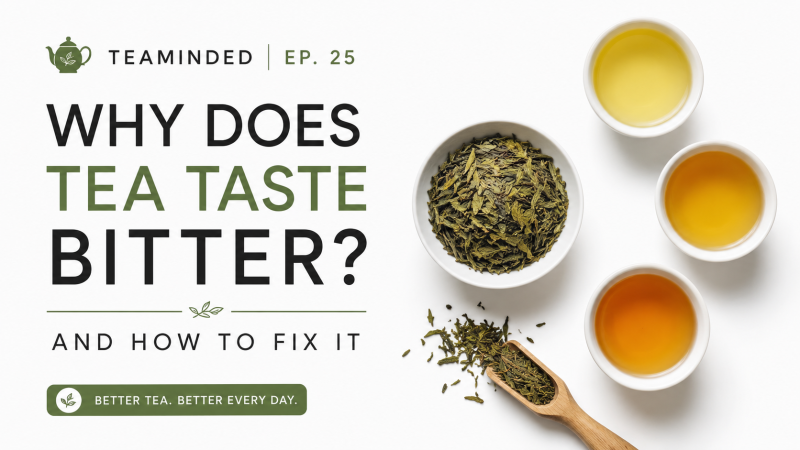
This article accompanies TeaMinded Podcast Episode 25: Why Does Tea Taste Bitter? And How to Fix It.
TeaMinded explores tea culture, loose leaf tea, Japanese tea, craftsmanship, brewing, tea rituals, mindfulness, and intentional living through the lens of tea.
Put the kettle on.
Experiment with your next cup.
And stay TeaMinded.

Scott is the founder of TeaMinded. He enjoys tasting and discovering teas from across the globe, with green teas and ceremonial matcha from Japan being among his favorites. He’s grateful to be immersed in the tea community, always learning and sharing along the journey.