
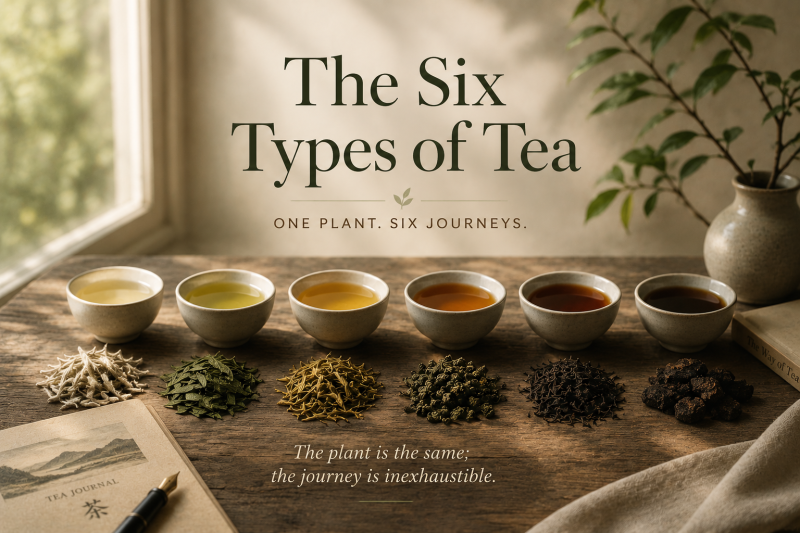
All true tea comes from a single plant. Here’s what happens after the harvest, and why it changes everything.
By TeaMinded ~12 min read
There are thousands of teas in the world. Different names, different countries, different flavors, different colors, different rituals surrounding them. But here is the fact that surprises most people when they first encounter it:
Every true tea — black, green, white, oolong, pu erh, and yellow — comes from a single plant: Camellia sinensis.
Not different plants. Not different species (with one nuanced exception, discussed below). One plant. What transforms it into six dramatically different beverages is entirely a matter of what happens after the leaves are picked — how much they are allowed to oxidize, how they are heated, dried, aged, or shaped.
Understanding this changes how you think about tea entirely. A first-flush Darjeeling and a grassy Japanese sencha and a smoky Yunnan pu erh all begin as leaves from the same botanical family. The tea maker’s craft, decisions made in the hours and days following harvest, determines everything else.
This is the foundational guide. Whether you are just beginning your tea journey or deepening an existing practice, understanding the six types gives you a framework for everything that follows.
Quick Navigation
- What Is Camellia sinensis?
- The Six Types of Tea
- What About Herbal Tea?
- Oxidation: The Key to Understanding All Six
- Which Type Should You Start With?
- Frequently Asked Questions
What Is Camellia sinensis?
Camellia sinensis is an evergreen shrub native to East Asia, primarily the mountainous regions of southwestern China and northern Myanmar. Left to grow wild, it becomes a tree. In cultivation, tea farmers keep it pruned to waist height to make harvesting practical and to encourage a continuous flush of young, tender leaves.
There are two primary varieties:
- Camellia sinensis var. sinensis — the small-leaved Chinese variety, used for most green, white, yellow, and oolong teas. More cold-hardy, more delicate in flavor.
- Camellia sinensis var. assamica — the large-leaved Assam variety, used for most black teas and pu erh. More robust, higher in caffeine, better suited to hot, humid lowland climates.
The character of the final tea is shaped by three interlocking forces: the variety of the plant, the terroir of where it grows (altitude, soil, rainfall, temperature), and the processing method applied after harvest.
Of these three, processing is the most powerful variable. The same leaves picked from the same garden on the same day can be made into white, green, or black tea depending entirely on what the tea maker does next.
The Six Types of Tea
1. White Tea
Oxidation level: Minimal (0–15%)
White tea is the least processed of all true teas. The leaves, ideally young buds and early shoots, are simply picked and dried, either in the sun or in a temperature-controlled room, with no rolling, no firing, and no intentional oxidation. What happens during the slow drying is a very gentle, natural oxidation that gives white tea its characteristic pale gold or ivory color and subtle sweetness.
The name comes from the fine white hairs (bai hao) that cover the young buds, giving them a silvery-white appearance before drying.
Flavor Profile
Soft, delicate, and lightly sweet. Notes of honey, melon, fresh hay, and wildflower. The flavor is subtle, and sometimes deceptively subtle for drinkers expecting intensity.
Caffeine
Lower than black tea, though not caffeine-free. Young buds actually contain high concentrations of caffeine, but because white tea is brewed at lower temperatures for shorter times, less is extracted.
Origin
White tea is most closely associated with Fujian province, China, particularly the counties of Fuding and Zhenghe. The two most celebrated varieties are:
- Bai Hao Yin Zhen (Silver Needle) — made entirely from unopened buds; the most prized and expensive white tea
- Bai Mu Dan (White Peony) — made from one bud and two leaves; more accessible, fuller in flavor
How to Brew
Use water around 75–80°C (167–176°F). Steep for 2–3 minutes. Use more leaf than you think you need, as the fluffy, undense buds require a generous amount. A good loose-leaf infuser or a glass teapot shows off the leaves beautifully.
What to Buy
Look for Silver Needle from Fuding or White Peony loose leaf from reputable importers. Avoid white tea bags as the fannings inside bear little resemblance to the real thing.
2. Green Tea
Oxidation level: Minimal (0–10%)
Green tea is defined by one critical step that white tea skips: heat is applied shortly after harvest to stop oxidation entirely. This process — called “kill-green” or shāqīng in Chinese — deactivates the enzymes responsible for oxidation and locks the leaf in its fresh, green state.
The method of applying heat varies significantly between tea cultures and produces very different results:
- Pan-firing (the Chinese tradition) — leaves are tumbled in a hot wok or pan, producing a roasted, toasty character
- Steaming (the Japanese tradition) — leaves are steamed with moist heat, producing a brighter, more vegetal, grassy flavor
This difference — pan-fired Chinese green vs. steamed Japanese green — is one of the most fundamental distinctions in tea. They are not just different styles; they taste genuinely different and suit different moments.
Flavor Profile
Chinese greens: Roasted, nutty, sweet, slightly toasty. Think Dragon Well (Longjing) from Hangzhou — flat, jade-green leaves with a chestnut sweetness.
Japanese greens: Vegetal, grassy, umami-rich, oceanic. Think Sencha or Gyokuro, with vibrant green leaves with a rich savory depth.
Matcha is also a green tea that is shade-grown, stone-ground to a fine powder, and consumed whole rather than steeped. For a full dive into matcha specifically, read our Complete Guide to Matcha Tea on TeaMinded.
Caffeine
Moderate. Japanese greens tend to be higher in caffeine than Chinese greens; shade-grown varieties like gyokuro and matcha are highest of all.
Health Benefits
Green tea is among the most studied beverages in nutritional science. Its high concentration of catechins — particularly EGCG (epigallocatechin gallate) — is associated with antioxidant protection, heart health, and metabolic support. The Harvard T.H. Chan School of Public Health maintains an overview of the current research.
How to Brew
This is where most beginners go wrong: never use boiling water on green tea. Use 75–85°C (167–185°F) and steep for 1.5–2.5 minutes. Boiling water scorches the leaves, releasing bitter tannins and destroying the delicate catechins you’re drinking green tea for in the first place.
What to Buy
For Chinese greens: Longjing (Dragon Well) loose leaf or Bi Luo Chun. For Japanese greens: ceremonial-grade sencha, gyokuro, or a beginner’s Japanese green tea sampler.
3. Yellow Tea
Oxidation level: Minimal, with a unique additional step
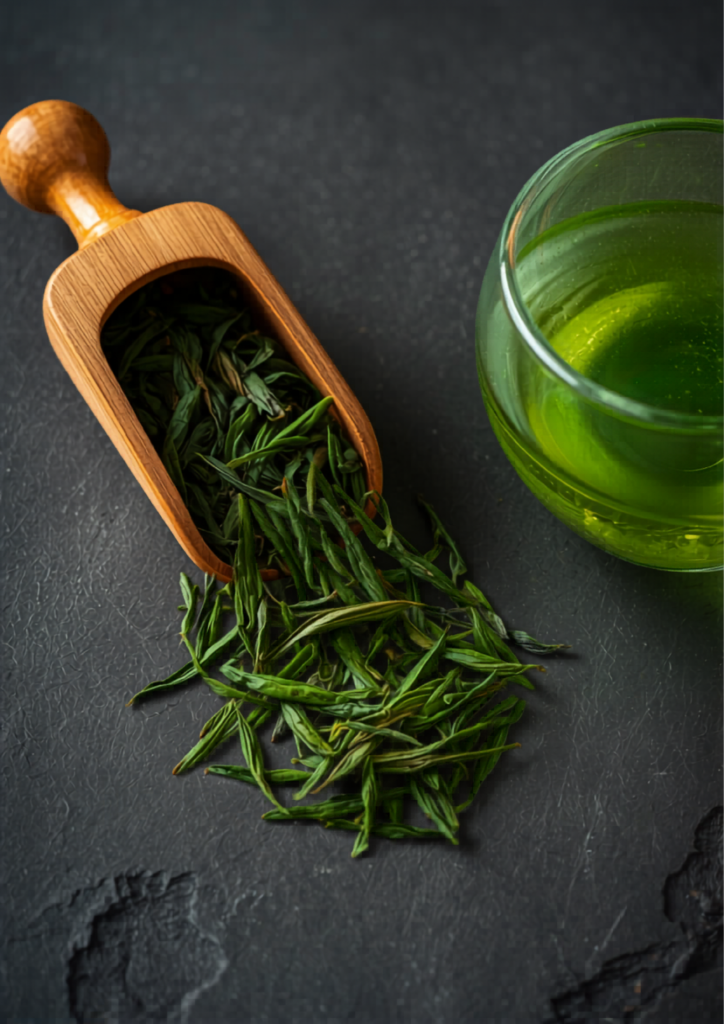
Yellow tea is the rarest of the six types and the least known outside of China. In production, it begins like green tea — the leaves are heated to stop oxidation. But then a unique step is added: the leaves are wrapped in cloth or paper and allowed to rest in a warm, moist environment for anywhere from a few hours to several days. This process, called men huan (“sealing yellow”), causes a slow, moist transformation that mellows the grassy sharpness of green tea into something gentler, smoother, and slightly sweet.
The result is a tea that sits uniquely between green and white: less vegetal than green, more complex than white, with a mellow warmth that is difficult to describe until you’ve tasted it.
Flavor Profile
Smooth, mellow, slightly sweet. Lower astringency than green tea. Notes of melon, chestnut, and a gentle floral quality. Often described as “easy to drink” — there’s no bitterness, no grassiness, just a soft, rounded cup.
Why It’s Rare
The additional processing step requires significant skill and time. Few producers still make it. Much of what is sold as yellow tea is actually a light green tea, which is authentic yellow tea from reputable sources commands a premium.
Notable Varieties
- Jun Shan Yin Zhen — from Junshan Island, Hunan Province; made from all-bud silver needles
- Meng Ding Huang Ya — from Sichuan Province; historically among the most celebrated of imperial tribute teas
How to Brew
Similar to green tea: 75–80°C (167–176°F), 2–3 minutes. Use a glass gaiwan or glass teapot if possible, as yellow tea’s color and leaf movement are part of the experience.
What to Buy
Seek out authentic Jun Shan Yin Zhen from a trusted Chinese tea importer. This is a category where provenance matters, so buy from a source that can tell you exactly where and when it was made.
4. Oolong Tea
Oxidation level: Partial (15–85%)
Oolong sits between green and black tea on the oxidation spectrum — and spans an enormous range within that space. A lightly oxidized oolong (15–30%) tastes and smells closer to a floral green tea. A heavily oxidized oolong (70–85%) is closer to a mellow, fruity black tea. Between those extremes lies extraordinary diversity.
What all oolongs share is a partial oxidation process that is deliberately interrupted by the tea maker — and the hallmark of great oolong production is knowing precisely when to stop.
The Production Process
After picking and a brief outdoor withering, oolong leaves are gently bruised or shaken (a step called “tossing” or yao qing) to encourage oxidation to begin at the edges of the leaf while the center remains green. The tea maker monitors the leaves carefully — checking color, aroma, and temperature — before applying heat to arrest oxidation at exactly the right moment. The leaves are then rolled (either into tight balls or long twisted strips) and dried.
This combination of skill, timing, and environmental conditions makes oolong the most complex category in terms of production.
Flavor Profile
The range is extraordinary:
- Light oolongs (15–30% oxidized): Floral, fresh, orchid-like, creamy. Think Taiwanese High Mountain Oolong (Ali Shan) or Jin Xuan “Milk Oolong”
- Medium oolongs (30–60% oxidized): Fruity, peachy, complex. Think Dan Cong (Phoenix Oolong) from Guangdong
- Dark oolongs (60–85% oxidized): Rich, roasted, caramel, dried fruit. Think Wuyi Rock Oolong (Da Hong Pao) or Taiwanese Dong Ding
Notable Origin Regions
- Fujian Province, China — home of Wuyi Rock Oolongs (among the most prized teas in the world) and Tie Guan Yin
- Guangdong Province, China — home of Dan Cong, produced on single trees selected for specific aroma profiles
- Taiwan — home of High Mountain Oolongs, with complex terroir driven by altitude and cool temperatures
Oolong’s complexity makes it a deep rabbit hole. Once you start exploring, the category alone can sustain a lifetime of tasting.
How to Brew
Traditional gongfu-style brewing in a Yixing clay teapot or ceramic gaiwan is ideal — multiple short infusions (30 seconds to 2 minutes) that evolve across the session. Western-style brewing also works: 85–95°C (185–205°F), 2–4 minutes, depending on oxidation level. Heavier oolongs tolerate more heat; lighter oolongs need the lower end.
What to Buy
Tie Guan Yin (Iron Goddess of Mercy) is the classic entry point. High Mountain Ali Shan is an excellent introduction to Taiwanese oolong. For something more adventurous, Wuyi Rock Oolong sampler sets let you explore the range.
5. Black Tea
Oxidation level: Full (100%)
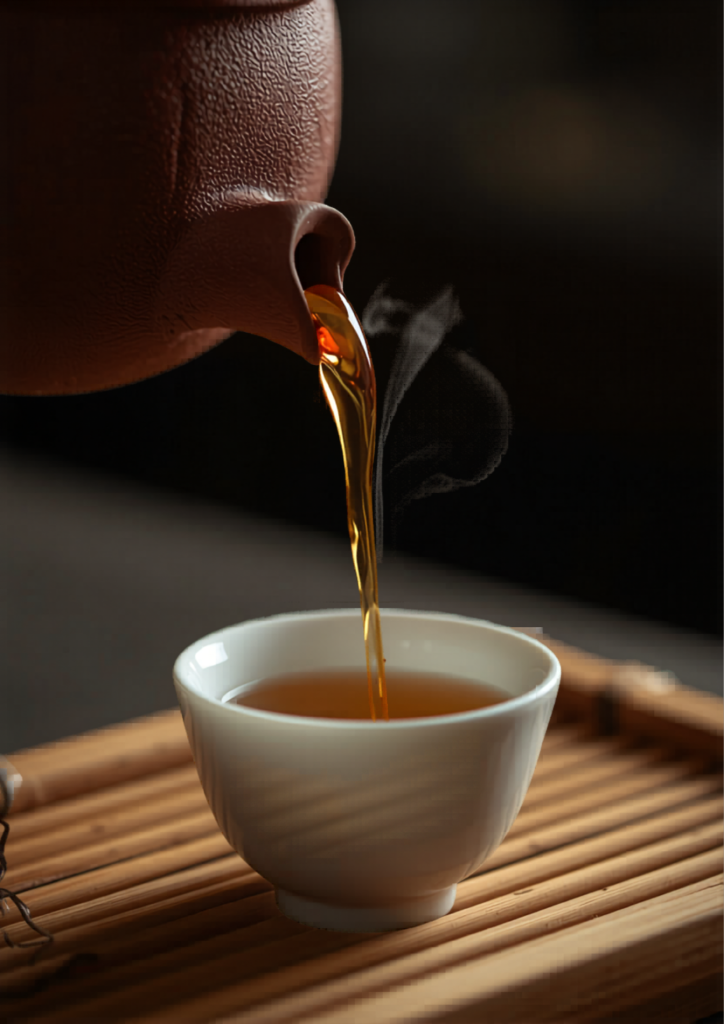
Black tea is fully oxidized, which is why it’s dark in color, robust in flavor, and longer-lasting in storage than more delicately processed teas. In most of the world outside East Asia, “tea” means black tea. It is the tea in English breakfast blends, Earl Grey, chai, and the vast majority of commercial tea bags.
In China, black tea is called hong cha — “red tea” — referring to the reddish-amber color of the brewed liquor rather than the dark appearance of the dry leaves. This distinction matters: what the rest of the world calls “black tea” and what China calls “red tea” are the same thing. (And what South Africans call “red tea” is rooibos — an entirely different plant, not a true tea at all.)
The Production Process
After picking and withering, the leaves are rolled (which breaks open cell walls to accelerate oxidation), then spread out and allowed to fully oxidize until the leaves turn from green to deep brown or black. Heat is then applied to halt oxidation and lock in flavor. The result is a tea with high tannin content, a bold flavor profile, and a long shelf life.
Flavor Profile
Ranges from the malty, brisk punch of Assam CTC tea (classic breakfast tea) to the muscatel floral complexity of Darjeeling second flush, the smoky depth of Lapsang Souchong, and the bergamot-scented elegance of Earl Grey loose leaf. For a full exploration of the most celebrated black tea origin, read our Complete Guide to Darjeeling Tea on TeaMinded.
Caffeine
Highest of the six types (excluding concentrated preparations like matcha). A typical cup of black tea contains 40–70mg of caffeine, though this varies widely based on leaf grade, steeping time, and temperature.
Notable Varieties and Origins
- Assam, India — bold, malty, high-caffeine; the backbone of most breakfast blends
- Darjeeling, India — floral, muscatel, complex; the “Champagne of Teas”
- Ceylon (Sri Lanka) — bright, brisk, citrusy; works beautifully iced
- Keemun, China — rich, wine-like, orchid-scented; the classic Chinese black tea
- Yunnan, China — smooth, peppery, chocolatey; particularly [Yunnan Golden Tips]
- Lapsang Souchong, China — smoke-dried over pine wood; one of the most distinctive teas in existence
How to Brew
Most black teas welcome 95–100°C (205–212°F) water and 3–5 minutes of steeping. Higher-quality blacks (like Darjeeling first flush) benefit from slightly cooler water to preserve delicacy. A [cast iron teapot] or [ceramic teapot with infuser] keeps water hot throughout the session.
What to Buy
Assam loose leaf tea for classic breakfast drinking. Darjeeling second flush single estate for something special. Earl Grey with bergamot oil (not artificial flavoring) for an everyday luxury. A black tea sampler is a great way to explore the category.
6. Pu Erh Tea
Oxidation level: Variable — plus microbial fermentation
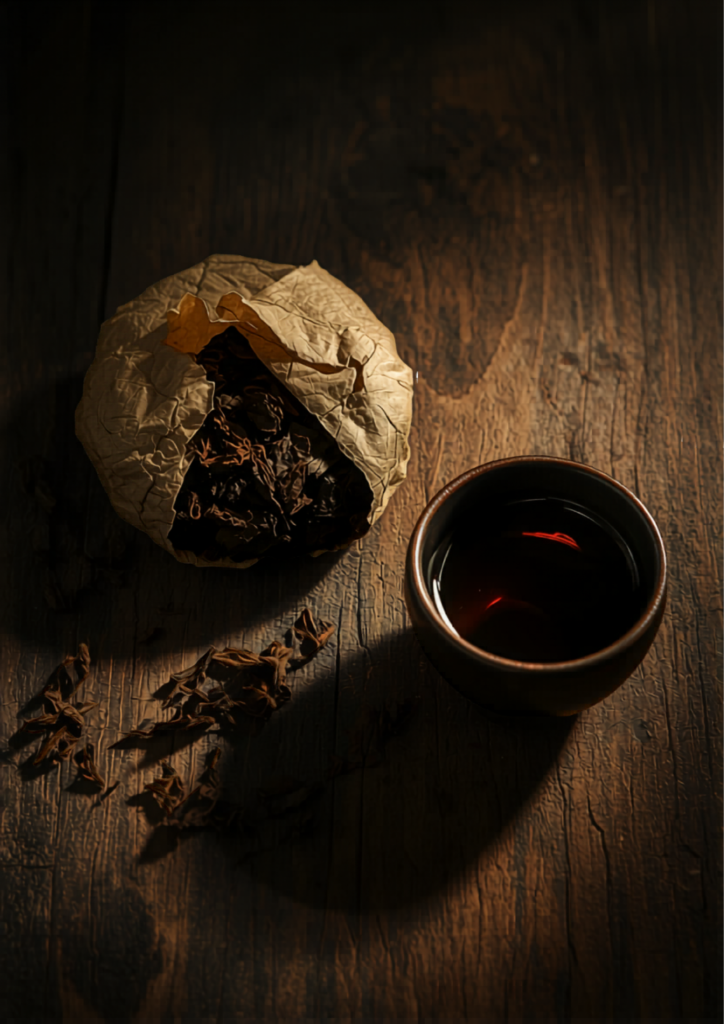
Pu erh is in a category of its own. Unlike the other five types, pu erh undergoes microbial fermentation — actual microbial activity by bacteria and fungi transforms the leaf at a chemical level over time. The result is a tea that improves with age (like wine or cheese), can be stored for decades, and develops flavors that have no parallel elsewhere in the tea world.
Pu erh is produced primarily in Yunnan Province, China, from ancient Camellia sinensis var. assamica trees — some of which are hundreds or even thousands of years old. The large, mature leaves of old-growth trees (“gushu” or ancient tree pu erh) are prized above all others.
Two Completely Different Styles
There are two fundamentally different types of pu erh, produced by entirely different processes:
Sheng Pu Erh (Raw / Green) Made from leaves that are sun-dried but not fermented industrially. Sheng pu erh is compressed into cakes and stored for natural, slow aging — a process that unfolds over years and decades. Young sheng is bold, bitter, and astringent. Aged sheng (10, 20, 30+ years) becomes smooth, complex, and deeply earthy, with notes of camphor, dried fruit, and forest floor. A well-aged sheng cake from a reputable estate is among the most expensive teas in the world.
Shou Pu Erh (Ripe / Cooked) Developed in the 1970s to accelerate the aging process commercially, shou pu erh undergoes a controlled “wet piling” fermentation (wo dui) that achieves in weeks what natural aging takes decades to produce. Shou is smooth, dark, and earthy from the first cup — accessible, non-bitter, and an excellent entry point for new pu erh drinkers.
Flavor Profile
Sheng (young): Bitter, astringent, floral, wildly complex — not for beginners. Sheng (aged): Smooth, camphor, leather, dried fruit, deep forest notes — transformative. Shou: Dark, smooth, earthy, mushroom, wet earth, sometimes slightly sweet.
How to Brew
Traditional gongfu brewing is strongly recommended: a Yixing clay teapot seasoned for pu erh or ceramic gaiwan, near-boiling water (95–100°C), and multiple short infusions. The first infusion is often discarded as a “rinse” to open the leaves and remove dust from aging or storage. For a complete brewing guide, read our How to Brew Pu Erh Tea guide on TeaMinded.
What to Buy
For beginners: a shou pu erh mini cake or tuo cha sampler is the easiest entry point — smooth, earthy, and forgiving. For those ready to explore further: a sheng pu erh cake from Yunnan (3–5 years old) offers a glimpse of what aging does. Avoid cheap supermarket pu erh — the category rewards buying from knowledgeable importers.
What About Herbal Tea?
Here is the important clarification: herbal teas are not true teas. Chamomile, peppermint, rooibos, hibiscus, ginger, and every other “herbal tea” is technically a tisane — a beverage made by infusing plant material other than Camellia sinensis in hot water.
This is not a trivial distinction. True teas share a botanical heritage, a body of health research, a cultural tradition, and a set of flavor characteristics (including tannins, catechins, and varying caffeine) that herbal beverages do not. Herbal tisanes can be wonderful. Many have genuine health benefits. But they belong to a separate category.
The six types above — white, green, yellow, oolong, black, and pu erh — are the only true teas.
Oxidation: The Key to Understanding All Six {#oxidation}
If you want a single concept to carry away from this article, it is oxidation — the process that distinguishes every type of tea from every other.
When a tea leaf is picked and its cells are damaged (by bruising, rolling, or simply the passage of time), enzymes in the leaf react with oxygen in the air and begin to transform the leaf’s chemistry. Chlorophyll breaks down. Tannins develop. Color shifts from green to copper to brown to black. Flavor moves from fresh and vegetal to floral to fruity to bold and malty.
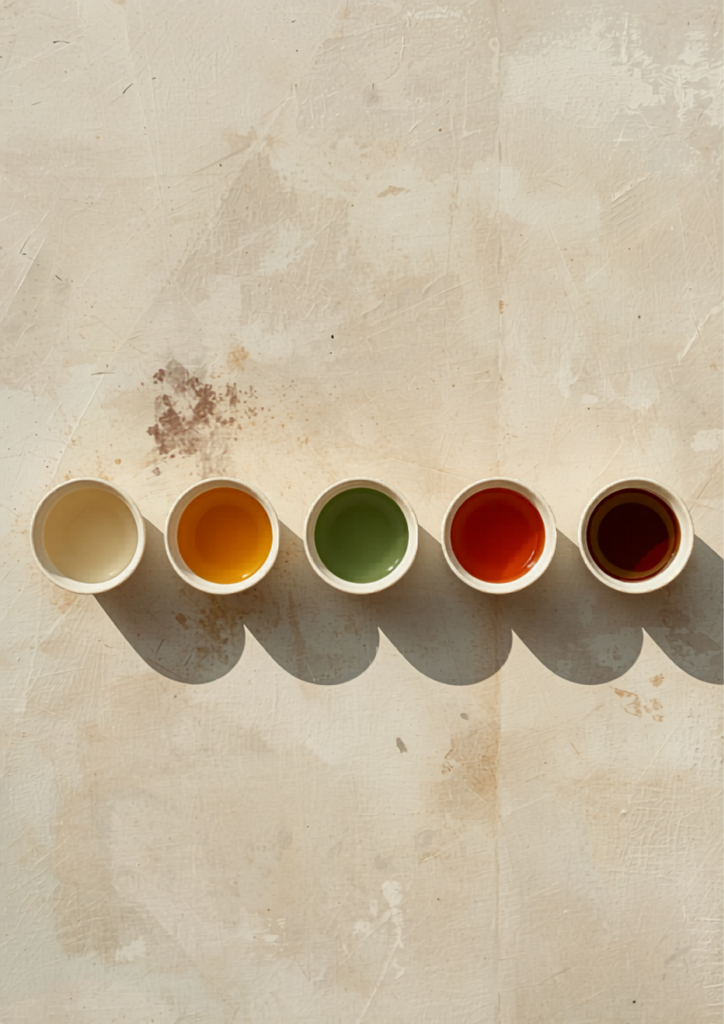
| Tea Type | Oxidation Level | Color of Liquor | General Flavor Direction |
|---|---|---|---|
| White | 0–15% | Pale gold / ivory | Delicate, sweet, floral |
| Green | 0–10% | Pale to bright green | Fresh, vegetal, grassy, nutty |
| Yellow | Minimal + rest | Pale yellow / gold | Mellow, smooth, soft |
| Oolong | 15–85% | Gold to dark amber | Floral → fruity → roasted |
| Black | 100% | Amber to deep red | Bold, malty, brisk, complex |
| Pu Erh | Variable + fermented | Deep amber to near-black | Earthy, complex, evolving |
Every decision in tea processing — how long the leaf is left to wither, whether it is bruised, how quickly heat is applied, and how long it ages — is a decision about managing oxidation. The tea maker’s craft is, in its most essential form, the art of controlled transformation.
Which Type Should You Start With?
There’s no wrong answer, but here is a practical guide based on what you already enjoy:
If you drink coffee: Start with black tea — particularly a good Assam or Yunnan. The boldness and caffeine level will feel familiar.
If you drink coffee but want to cut caffeine: Start with oolong — a medium-oxidized Tie Guan Yin or High Mountain oolong offers complexity and depth without black tea’s full intensity.
If you want maximum health benefits: Start with green tea — specifically Japanese sencha or matcha. These are the most studied categories for health.
If you want something gentle and soothing: Start with white tea — Silver Needle or White Peony. The softest entry point into true tea.
If you’re drawn to something unusual: Try pu erh — specifically shou (ripe) pu erh. The earthy, smooth character is unlike anything else.
If you love exploring rare things: Seek out yellow tea — Jun Shan Yin Zhen if you can find it. It’s a category most tea drinkers have never experienced.
Wherever you begin, invest in a simple loose-leaf infuser and buy the best quality you can afford for a single variety before expanding. The difference between good tea and mediocre tea is far greater than the difference between tea types.
Frequently Asked Questions
Do all six types of tea come from the same plant? Yes. White, green, yellow, oolong, black, and pu erh all come from Camellia sinensis. The differences are entirely a result of post-harvest processing.
Which tea has the most caffeine? Generally, black tea and matcha (a powdered green tea) are highest. Pu erh is also relatively high. White tea, despite being made from young buds (which contain concentrated caffeine), typically delivers less caffeine per cup because it is brewed at lower temperatures.
Which tea is healthiest? All true teas contain beneficial polyphenols and antioxidants. Green tea is the most studied for health benefits, particularly its EGCG content. White tea retains similar compounds in a less-processed form. The healthiest tea is the one you actually drink consistently.
What is the difference between loose leaf and tea bags? Tea bags typically contain “fannings” or “dust” — the smallest particles left over from processing whole leaves. These brew quickly and strongly but lack the nuance, complexity, and health-compound concentration of whole loose leaves. Loose leaf tea is always the better choice for flavor, health, and environmental impact.
Can you add milk to any type of tea? Milk complements bold black teas well (Assam, Breakfast blends) — it softens tannins and adds richness. For green, white, yellow, and most oolongs, milk masks the very characteristics worth experiencing. Pu erh is occasionally served with dairy in Tibetan butter tea traditions, but Western-style milk is not common.
What is the rarest type of tea? Yellow tea is the rarest — produced in tiny quantities, by a shrinking number of skilled producers, using a process that takes time and expertise with no industrial shortcut. Truly authentic yellow tea is difficult to find and worth seeking out.
The Bottom Line
Tea’s extraordinary diversity — across flavor, culture, health benefits, and ritual — emerges from a single plant and a single variable: how much transformation the leaf undergoes between garden and cup.
White tea is the leaf barely touched. Pu erh is the leaf transformed over decades. Between them lie four other categories, each with its own craft, culture, and character.
The six types are not just a taxonomy. They are an invitation. Pick one. Brew it carefully. Pay attention. Then try another. The plant is the same; the journey is inexhaustible.
Published by TeaMinded | Your trusted resource for tea education, culture, and discovery

Scott is the founder of TeaMinded. He enjoys tasting and discovering teas from across the globe, with green teas and ceremonial matcha from Japan being among his favorites. He’s grateful to be immersed in the tea community, always learning and sharing along the journey.