
If you’ve ever stood in the tea aisle wondering whether to reach for Earl Grey or Lady Grey, you’re not alone. These two bergamot-scented black teas are closely related — but their flavor profiles, histories, and ideal occasions set them distinctly apart. Whether you’re a seasoned tea drinker or just getting started, this guide will help you understand exactly what separates them and which one belongs in your cup.
Quick Navigation
What Is Earl Grey Tea?
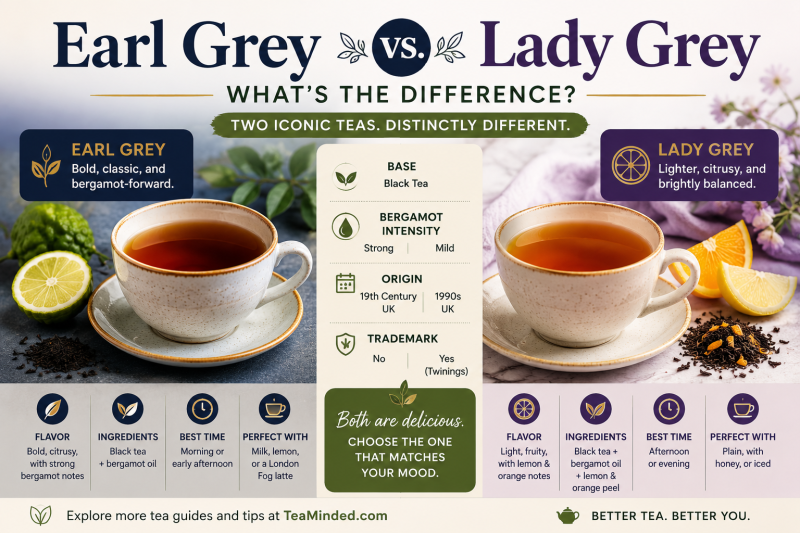
Earl Grey is one of the most iconic tea blends in the world, with a history stretching back to the 19th century. It’s made from black tea leaves — traditionally sourced from China (Keemun), India (Darjeeling or Assam), or Sri Lanka (Ceylon) — infused with oil extracted from the rind of the bergamot orange, a small citrus fruit grown primarily in Calabria, Italy.
The tea is named after Charles Grey, the 2nd Earl Grey and Prime Minister of the United Kingdom in the 1830s. Legend has it that he was given a bergamot-scented tea as a diplomatic gift during a visit to China and commissioned a British tea merchant to replicate it. Whether or not that story is entirely accurate, the blend he inspired became a global staple.
One important distinction: Earl Grey is not trademarked. That means every tea company produces its own version, which is why the flavor, strength, and quality can vary considerably from brand to brand. If you enjoy exploring different black tea styles, TeaMinded’s guide to Japanese green teas is a great companion read for understanding how tea origin and processing shape flavor.
Flavor profile: Bold, full-bodied, with a pronounced citrus-floral bergamot aroma. Best enjoyed black, with a splash of milk, or with a slice of lemon.
What Is Lady Grey Tea?
Lady Grey is a more recent invention — and a trademarked one. It was created by Twinings in the early 1990s specifically for Northern European and Scandinavian markets, where traditional Earl Grey was considered too robust. The blend adds lemon peel and orange peel to the classic Earl Grey base, resulting in a lighter, fruitier, more delicate cup with a softer bergamot note.
The name was inspired by Mary Elizabeth Grey, Countess Grey — the wife of Earl Charles Grey — who helped introduce her husband’s distinctive tea to London high society. Because the name is trademarked exclusively to Twinings, other tea companies that make similar blends must sell them under different names, though the formula (black tea + bergamot + citrus peel) is widely replicated.
Flavor profile: Lighter and fruitier than Earl Grey, with lemon and orange notes that soften the bergamot. Smooth, subtly citrusy, and less astringent.
For a deeper dive into what makes different tea types unique, see TeaMinded’s complete guide to matcha tea — another tea with a fascinating origin story and distinct preparation method.
Earl Grey vs. Lady Grey: Key Differences at a Glance
| COMPARE: | Earl Grey | Lady Grey |
|---|---|---|
| Base | Black tea | Black tea |
| Flavoring | Bergamot oil | Bergamot oil + lemon peel + orange peel |
| Bergamot strength | Strong, prominent | Mild, subtle |
| Flavor | Bold, floral, citrusy | Light, fruity, gentle |
| Trademarked? | No — many producers | Yes — Twinings only |
| Origin | 19th century, UK | Early 1990s, UK |
| Tea source | Keemun, Darjeeling, Assam, Ceylon | Primarily Ceylon/China blends |
| Best for | Morning, afternoon | Afternoon, evening |
Similarities Between Earl Grey and Lady Grey
Despite their differences, these two teas share a significant amount in common:
Caffeine content: Both are black tea-based and contain roughly 14–60 mg of caffeine per 8-ounce cup — comparable to one another, though individual variation by brand and steep time applies.
Brewing method: Both are best brewed at around 200°F (93°C) for 3 to 5 minutes. Use one teaspoon of loose leaf per cup, or one tea bag, with fresh water. Both can be enjoyed plain, with milk, with honey, or with a slice of lemon.
Health benefits: As black teas, both Earl Grey and Lady Grey contain antioxidant polyphenols that have been associated with heart health, improved mood, and protection against free radicals. Research has also suggested that regular tea consumption — around three cups per day — may reduce the relative risk of depression.
Versatility: Both work well hot or iced and pair nicely with baked goods, scones, and light sandwiches — classic afternoon tea accompaniments.
How Do They Taste Different?
This is the crux of the matter for most tea drinkers. Earl Grey leads with bergamot — that distinctive floral-citrus oil that gives the blend its unmistakable character. The black tea base adds body and mild astringency, and the overall impression is bold and aromatic.
Lady Grey takes that same foundation and turns down the bergamot while adding brightness from lemon and orange peel. The result is a more complex citrus profile that spreads across a wider, fruitier spectrum rather than putting bergamot front and center. It’s less assertive, less tannic, and considerably gentler on the palate — particularly appealing to those who find Earl Grey too intense.
As Nelson’s Tea puts it, Earl Grey is bergamot-forward; Lady Grey spreads the citrus across a wider, brighter spectrum. Nelson’s Tea
Which One Should You Choose?
Choose Earl Grey if you:
- Prefer a bold, full-flavored morning tea
- Enjoy a strong citrus-floral aroma
- Like your tea with milk or as the base for a London Fog latte
- Are an experienced tea drinker comfortable with robust black tea
Choose Lady Grey if you:
- Prefer a lighter, more delicate cup
- Are new to bergamot-flavored teas
- Want something calming for the afternoon or evening
- Prefer a fruitier, less astringent flavor
Earl Grey Variations Worth Knowing
Since Earl Grey isn’t trademarked, it has spawned a wide family of variations:
Russian Earl Grey adds lemon grass and citrus peel alongside bergamot — bringing it closer to Lady Grey in character. Earl Green Grey swaps the black tea base for green tea, creating a lighter, more vegetal cup. Rooibos Earl Grey is caffeine-free, with a naturally sweet, earthy base that pairs well with bergamot. Empress Grey (sometimes called Madame Grey) incorporates lavender, vanilla, or floral additions for a more aromatic experience.
Lady Grey, by contrast, always tastes the same — because it can only come from Twinings.
Brewing Tips for Both Teas
For the best cup of either Earl Grey or Lady Grey:
Use freshly filtered water heated to around 200°F — not a full rolling boil, which can make black tea bitter. Steep for 3 to 4 minutes for a balanced flavor; longer steeping increases astringency. Avoid squeezing the tea bag, which releases bitter tannins. If using loose leaf, a standard measure is one teaspoon per 8 oz cup. Both teas welcome milk, honey, or a citrus slice — though purists often enjoy Earl Grey black to appreciate the bergamot fully.
Frequently Asked Questions
Is Lady Grey just a weaker Earl Grey? Not exactly. Lady Grey uses less bergamot and adds lemon and orange peel, which creates a different — not simply milder — flavor profile. It’s fruitier and more layered, not just a diluted Earl Grey.
Can other brands make Lady Grey? The name “Lady Grey” is trademarked by Twinings, so other companies cannot use it. However, many produce similar blends under different names.
Which has more caffeine — Earl Grey or Lady Grey? They’re effectively the same. Both use a black tea base with a similar caffeine range per cup.
Is Earl Grey good for you? Like other black teas, Earl Grey contains antioxidants associated with heart health and reduced inflammation. The bergamot itself has also been studied for potential cholesterol-lowering properties, though more research is needed.
Conclusion
Earl Grey and Lady Grey are two expressions of the same elegant tradition — bergamot-kissed black tea — interpreted for different palates. Earl Grey delivers a confident, aromatic boldness that has made it one of the world’s most beloved blends for nearly two centuries. Lady Grey softens and brightens that formula for those who prefer a gentler, fruitier cup. Both are worth a place in your tea collection.

Scott is the founder of TeaMinded. He enjoys tasting and discovering teas from across the globe, with green teas and ceremonial matcha from Japan being among his favorites. He’s grateful to be immersed in the tea community, always learning and sharing along the journey.