
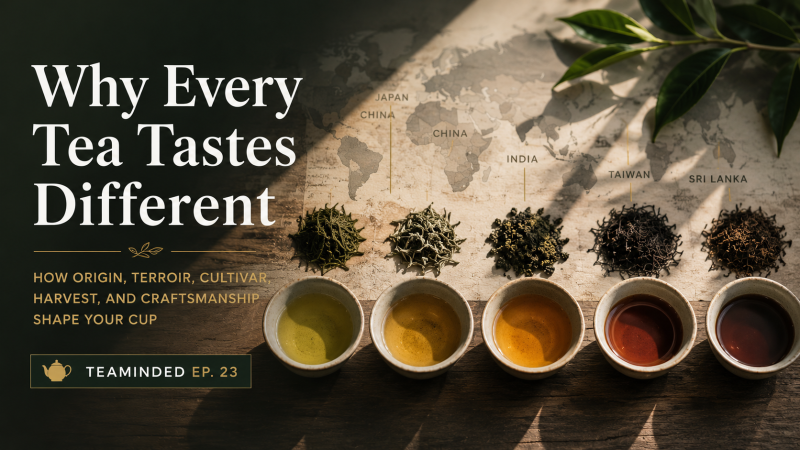
A fresh, grassy Japanese sencha.
A rich, malty Assam.
A floral Taiwanese oolong.
A delicate white tea.
A complex Darjeeling.
These teas can taste remarkably different from one another.
And yet they can all come from essentially the same plant:
Camellia sinensis.
That raises one of the most interesting questions in the world of tea:
If so many teas come from the same plant, why do they taste so different?
The answer involves an extraordinary combination of geography, climate, soil, elevation, tea cultivars, harvest seasons, processing methods, craftsmanship—and even the way you brew the tea at home.
Once you begin understanding these variables, tea stops tasting simply like “tea.”
You begin tasting places.
Seasons.
Plants.
Craftsmanship.
And the decisions of the people who transformed freshly picked leaves into the tea in your cup.
Quick answer: Tea tastes different because flavor is shaped by the tea plant’s cultivar, where and how it is grown, when the leaves are harvested, which leaves are picked, how they are processed, and how the finished tea is brewed. Even teas made from the same Camellia sinensis plant can therefore taste dramatically different.
Quick Navigation
Most Traditional Tea Comes From the Same Plant
One of the first things many people learn when exploring specialty tea is also one of the most surprising.
Green tea, black tea, white tea, oolong, pu-erh, and other traditional teas generally come from Camellia sinensis.
They aren’t simply leaves from completely different plants.
What happens before and after those leaves are picked creates much of the extraordinary diversity we experience in tea.
If you’d like to understand these categories more deeply, TeaMinded’s guide to The Six Types of Tea Explained explores how processing helps transform the same tea plant into remarkably different styles.
This also means that labels such as “green tea” or “black tea” tell us only part of the story.
Two green teas can taste very different.
Two black teas can taste very different.
Even two teas produced in the same region can have noticeably different characteristics.
Why?
Let’s start with where the tea grows.

Origin: Tea Can Taste Like Where It Comes From
Tea is grown across an enormous range of environments.
China.
Japan.
India.
Taiwan.
Sri Lanka.
Nepal.
Kenya.
And many other countries.
Within those countries are individual regions, mountains, valleys, farms, gardens, and estates.
Each growing environment has its own combination of:
- Climate
- Soil
- Rainfall
- Elevation
- Temperature
- Sunlight
- Humidity
- Seasonal weather patterns
These conditions influence how the tea plant grows.
And eventually, they can influence how the tea tastes.
7
A tea grown slowly at high elevation in cool, misty conditions may develop very differently from a tea growing in a warm, humid valley.
This is why origin isn’t simply an interesting detail printed on a package.
Place can become part of flavor.
Terroir: The Taste of Place
Wine drinkers may already be familiar with the French term terroir.
It’s difficult to translate with a single English word, but the basic idea is that an agricultural product reflects characteristics of the environment in which it was grown.
Soil matters.
Climate matters.
Elevation matters.
Rainfall matters.
Sun exposure matters.
Temperature matters.
The surrounding landscape can matter.
Tea provides a wonderful way to experience this idea.
Consider two of India’s most famous tea-growing regions.
Darjeeling
Darjeeling sits in the Himalayan foothills of northeastern India.
Many Darjeeling teas are known for characteristics that can be:
Floral.
Fruity.
Delicate.
Bright.
And sometimes distinctly muscatel.
Assam
Travel east into the lower-elevation Brahmaputra River valley of Assam and the character changes dramatically.
Assam teas are often:
Bold.
Malty.
Rich.
Full-bodied.
Sometimes honey-like.
TeaMinded’s guide to Indian tea varieties explores how dramatically teas from Darjeeling, Assam, Nilgiri, Sikkim, Kangra, and other Indian regions can differ.
Same tea species.
Different environments.
Very different cups.
This is terroir in action.

Cultivar: Not Every Tea Plant Is Identical
Saying all traditional tea comes from Camellia sinensis can create another misconception.
It doesn’t mean every tea plant is genetically identical.
There are numerous cultivars of the tea plant.
A cultivar is essentially a cultivated variety selected because it possesses particular characteristics.
Think about apples.
A Honeycrisp isn’t the same as a Granny Smith.
A Fuji isn’t the same as a Gala.
They’re all apples.
But they look, smell, feel, and taste different.
Tea works similarly.
Different cultivars may be selected for characteristics such as:
- Flavor
- Aroma
- Sweetness
- Umami
- Yield
- Disease resistance
- Cold tolerance
- Harvest timing
- Suitability for particular tea styles
Japan provides an especially interesting example.
Yabukita is the country’s dominant tea cultivar, but explore Japanese tea more deeply and you’ll encounter cultivars such as:
Saemidori.
Okumidori.
Asatsuyu.
Gokou.
Samidori.
And many others.
Taste several side by side and you may begin noticing meaningful differences.
One might seem sweeter.
Another more vegetal.
Another richer in umami.
Another especially aromatic.
So when you buy a tea that identifies the cultivar, don’t dismiss it as unnecessary information.
It’s another clue to understanding what’s in your cup.
Harvest Season Changes the Flavor of Tea
Tea is agriculture.
And agriculture changes with the seasons.
In many tea-growing regions, leaves are harvested multiple times during the year.
These harvest periods are sometimes called flushes.
The same garden—and sometimes the same tea plants—can produce noticeably different teas depending on when the leaves were harvested.
Darjeeling provides one of the clearest examples.
First Flush Darjeeling
The first major harvest follows the winter dormancy.
First-flush teas are often prized for characteristics that can be:
Fresh.
Bright.
Floral.
Light.
Delicate.
Second Flush Darjeeling
Later in the season, the character changes.
Second-flush teas are often:
Fuller.
Richer.
Fruitier.
And sometimes distinctly muscatel.
Same region.
Potentially the same estate.
Perhaps even the same plants.
Different season.
Different tea.
And the differences don’t stop with the season.
Weather changes from year to year.
Rainfall varies.
Temperatures fluctuate.
Sun exposure changes.
Agricultural conditions are never completely identical.
That’s part of what makes specialty tea interesting.
A tea can represent a particular place during a particular moment in time.

Which Leaves Are Picked Matters
Not every leaf on a tea plant is identical.
The young buds and tender leaves at the top of the plant have different characteristics from older, more mature leaves farther down.
Different styles of tea therefore call for different plucking standards.
You may encounter descriptions such as:
One bud and one leaf
or
One bud and two leaves.
Some teas rely heavily on young buds.
Others incorporate larger or more mature leaves.
The portion of the plant selected can influence the tea’s aroma, texture, flavor, chemical composition, and appearance.
And then the leaves leave the garden.
That’s when human craftsmanship becomes especially important.
Processing May Be the Biggest Transformation
Freshly picked tea leaves don’t automatically become sencha, Assam, white tea, or oolong.
People transform them.
Depending on the tea, processing can involve steps such as:
- Withering
- Rolling
- Bruising
- Steaming
- Pan-firing
- Oxidizing
- Shaping
- Roasting
- Drying
The sequence and intensity of those processes dramatically affect the finished tea.
This is one of the reasons understanding processing is so important to understanding flavor.
TeaMinded’s The Craftsmanship Behind a Good Cup of Loose Leaf Tea takes a closer look at the human knowledge and skill behind those decisions.
Processing isn’t merely industrial preparation.
At its best, tea making is a craft.
Why Japanese and Chinese Green Tea Can Taste So Different
Green tea offers a particularly useful example of how processing changes flavor.
One defining feature of green tea is that oxidation is limited relatively early during processing.
But tea makers don’t all accomplish that in exactly the same way.
Japanese Green Tea
Many Japanese green teas are heated using steam.
That processing can contribute to the fresh, vegetal, grassy, marine, and umami-rich characteristics associated with teas such as sencha.
Chinese Green Tea
Many Chinese green teas are heated using other methods, including pan-firing.
The resulting teas may lean toward flavors that are:
Nutty.
Toasty.
Sweet.
Vegetal.
Chestnut-like.
Both are green teas.
Both come from Camellia sinensis.
Yet the experience can be dramatically different.
That difference is craftsmanship.
Oxidation Changes Tea
Oxidation is one of the most important concepts to understand when learning about tea.
After tea leaves are picked and their cells are damaged through rolling, bruising, or other handling, naturally occurring compounds within the leaves begin reacting with oxygen.
Tea makers control this process to produce different styles of tea.
Very broadly:
Green tea undergoes minimal oxidation.
Black tea undergoes substantially more oxidation.
Oolong occupies an enormous spectrum between them.
This is an oversimplification—tea production is far more nuanced—but it provides a useful starting point.
The result is remarkable.
Leaves from the same plant can be transformed into completely different sensory experiences.
Purdue University Extension’s overview of tea similarly describes traditional tea categories as producing flavors ranging from grassy and delicate to malty, fruity, floral, smoky, and toasty.
Purdue University Extension tea resource
Oolong Shows Just How Diverse Tea Can Become
Few categories demonstrate the influence of processing better than oolong.
Oolong isn’t one flavor profile.
It’s an enormous universe.
Some oolongs are lightly oxidized and remarkably floral.
Others are more heavily oxidized.
Some are roasted.
Sometimes repeatedly.
Depending on the tea, you might encounter aromas and flavors reminiscent of:
Orchids.
Peaches.
Honey.
Cream.
Roasted nuts.
Caramel.
Minerals.
Stone fruit.
Toast.
Two oolongs can taste so different that someone unfamiliar with tea might reasonably assume they came from completely different plants.
That diversity is part of what makes oolong such a fascinating category to explore.
The Tea Maker Shapes the Final Cup
It’s easy to talk about tea entirely in terms of plants and geography.
But that misses an essential part of the story.
People make tea.
A skilled tea maker makes decisions throughout processing.
When should the leaves be harvested?
How long should they wither?
How aggressively should they be rolled?
How much oxidation is desirable?
When should oxidation stop?
How much heat should be applied?
Should the tea be roasted?
For how long?
These aren’t necessarily decisions made by following a timer and pressing a button.
For many traditional teas, they depend upon accumulated experience and judgment.
The leaves themselves may provide clues.
Their aroma.
Texture.
Moisture.
Appearance.
Temperature.
The tea maker responds.
This knowledge may have been developed over generations.
That’s why a good loose leaf tea isn’t simply an agricultural commodity.
It can also be an expression of human craftsmanship.
Brewing Changes the Tea Again
After all that work, there’s still one more person who influences how the tea tastes.
You.
The same leaves can produce dramatically different cups depending on how they’re brewed.
Important variables include:
- Water temperature
- Steeping time
- Amount of leaf
- Amount of water
- Water chemistry
- Brewing vessel
- Number of infusions
Take a delicate green tea and steep it in boiling water for five minutes.
It may become bitter and astringent.
Brew the same leaves using cooler water and a shorter infusion and you may discover sweetness, aroma, and complexity you didn’t notice before.
Water itself also plays a surprisingly large role. In How Water Changes the Taste of Tea, we explore how mineral content, filtration, chlorine, and temperature can influence the final cup.
The tea may be identical.
The brewing isn’t.
And therefore the experience isn’t either.
Why Two People Can Taste the Same Tea Differently
There’s one more variable we shouldn’t overlook.
The person drinking the tea.
Two people can sit at the same table.
Drink tea from the same pot.
And describe it differently.
One person might notice honey.
Another dried fruit.
Someone else flowers.
And someone else may simply say:
It tastes like really good tea.
None of those observations is necessarily wrong.
Taste is influenced by:
- Memory
- Culture
- Diet
- Previous experiences
- Personal sensitivity
- Familiarity with particular foods and aromas
- Expectations
This is why tasting notes should be treated as guides rather than answers.
If a tea package describes notes of orchid, peach, and honey and you don’t taste orchid, you haven’t failed.
You don’t need to find the flavor someone else told you was there.
Notice what you experience.
There Is No Single Correct Tasting Note
This is worth emphasizing because tasting language can sometimes make specialty tea feel intimidating.
You don’t need an extraordinary palate.
You don’t need to identify twelve aromas.
You don’t need to use poetic language.
Start simply.
Is the tea:
Sweet?
Bitter?
Floral?
Vegetal?
Fruity?
Roasted?
Light?
Rich?
Smooth?
Astringent?
Does the flavor disappear immediately?
Or linger after you’ve swallowed?
Those observations are already enough to begin developing your palate.
And over time, your vocabulary may become more specific.
“Fruity” becomes peach.
“Sweet” becomes honey.
“Roasted” becomes toasted almond.
But that comes through experience—not memorization.
How to Start Tasting the Differences Between Teas
One of the best ways to understand tea is to compare teas side by side.
Try two teas from the same category.
For example:
Japanese sencha vs. Chinese green tea
or
Assam vs. Darjeeling
or
two different oolongs.
Prepare them using appropriate brewing parameters.
Then pay attention.
Look at the dry leaves
Notice their:
Shape.
Size.
Color.
Texture.
Smell the leaves
What does the aroma remind you of?
Look at the brewed leaves
They may reveal far more about their original shape once they unfurl.
Smell the tea
Don’t rush straight to drinking it.
Take a sip
Notice:
Aroma.
Flavor.
Texture.
Sweetness.
Bitterness.
Astringency.
Finish.
Then go back to the other tea.
The differences often become easier to recognize through comparison.
From “Tea” to Thousands of Different Teas
When you first begin exploring tea, the categories may seem simple.
Green tea.
Black tea.
White tea.
Oolong.
Then the world begins opening.
Green tea becomes:
Sencha.
Gyokuro.
Longjing.
Bi Luo Chun.
Black tea becomes:
Assam.
Darjeeling.
Keemun.
Yunnan.
Oolong becomes:
Tieguanyin.
Wuyi rock tea.
Dan Cong.
Taiwanese high-mountain oolong.
And then you begin discovering individual regions.
Estates.
Mountains.
Cultivars.
Harvest seasons.
Tea makers.
Suddenly, saying “I like green tea” begins to sound a little like saying:
“I like fruit.”
It’s true.
But there’s an enormous world inside that statement.
Why Understanding Tea Makes Drinking It More Interesting
None of this means you need to become a tea expert.
You don’t need to memorize tea-growing regions.
You don’t need to know every cultivar.
And you certainly don’t need to analyze every cup you drink.
Sometimes you just want tea.
But knowing a little about what’s behind the cup can make tea considerably more interesting.
Look at the package next time.
Where was the tea grown?
Is a cultivar listed?
When was it harvested?
Was it steamed?
Pan-fired?
Oxidized?
Roasted?
Then taste it.
You may begin connecting the information with what you’re experiencing.
And eventually, something changes.
Tea stops tasting simply like tea.
Every Cup Has a Story
Perhaps that’s the real answer to why every tea tastes different.
Every tea has traveled a different path before reaching your cup.
A particular plant.
Growing in a particular place.
During a particular season.
Picked at a particular moment.
Processed by particular hands.
Then brewed…
by you.
That’s a remarkable amount of history inside something as ordinary as a cup of tea.
And perhaps that’s one of tea’s greatest lessons.
The more closely we pay attention to ordinary things, the less ordinary they become.
Frequently Asked Questions
Why do different teas taste different if they come from the same plant?
Traditional teas generally come from Camellia sinensis, but their flavor is influenced by cultivar, growing environment, harvest, leaf selection, processing, oxidation, roasting, storage, and brewing. These variables can produce dramatically different teas from the same plant species.
What is terroir in tea?
Terroir refers to the influence of a tea’s growing environment on its character. Climate, soil, elevation, rainfall, sunlight, temperature, and other environmental conditions can all contribute to differences between teas grown in different places.
What is a tea cultivar?
A cultivar is a cultivated variety of the tea plant selected for particular agricultural or sensory characteristics. Different cultivars can produce differences in aroma, flavor, sweetness, umami, growth patterns, and suitability for particular tea styles.
Does harvest season change how tea tastes?
Yes. Tea harvested at different points in the growing season can have noticeably different characteristics. Darjeeling’s first and second flushes are a well-known example.
Does processing affect the flavor of tea?
Processing is one of the biggest influences on tea flavor. Withering, rolling, oxidation, steaming, pan-firing, roasting, shaping, and drying can all alter the finished tea’s aroma, flavor, color, and texture.
Why does the same tea sometimes taste different when I make it?
Brewing variables such as water temperature, steeping time, leaf quantity, water chemistry, and brewing vessel can significantly change extraction and therefore the flavor of the finished tea.
Are tea tasting notes supposed to be exact?
No. Tasting notes are useful guides, not answers on a test. Individual taste perception is influenced by experience, memory, diet, culture, and personal sensitivity.
Final Thoughts
Why does every tea taste different?
Because tea is never just one thing.
It’s agriculture.
Geography.
Botany.
Weather.
Season.
Craftsmanship.
Chemistry.
Brewing.
And ultimately…
personal experience.
The next time you make tea, don’t worry about identifying everything in the cup.
Simply pay attention.
Try two teas side by side.
What’s sweeter?
What’s more aromatic?
Which feels lighter?
Which is richer?
Which flavor stays with you longer?
And most importantly:
Which one makes you want another cup?
That’s where learning about tea really begins.
Not with memorization.
With attention.
Listen to TeaMinded Episode 23
This article accompanies TeaMinded Podcast Episode 23: Why Every Tea Tastes Different — How Origin, Terroir, Cultivar, Harvest, and Craftsmanship Shape Your Cup.
TeaMinded explores tea culture, loose leaf tea, Japanese tea, craftsmanship, tea rituals, mindfulness, slow living, and intentional living through the lens of tea.
Put the kettle on.
Notice what’s in the cup.
And stay TeaMinded.

Scott is the founder of TeaMinded. He enjoys tasting and discovering teas from across the globe, with green teas and ceremonial matcha from Japan being among his favorites. He’s grateful to be immersed in the tea community, always learning and sharing along the journey.