
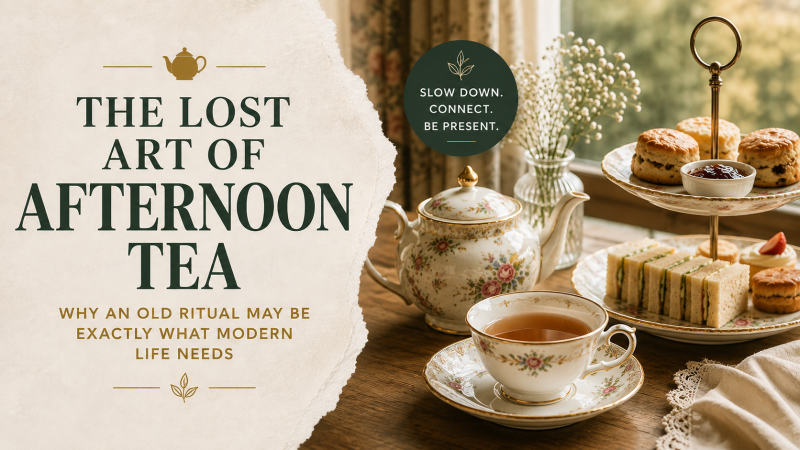
There was once a point in the afternoon when people simply stopped what they were doing and made tea.
Not because they were thirsty.
Not necessarily because they needed more caffeine.
They stopped because stopping was part of the ritual.
Today, our afternoons often look very different. We eat at our desks, move from one meeting to another, check messages between tasks, and reach for another coffee when our energy begins to fade.
Even when we take a break, we often fill it with something else.
We scroll.
Check the news.
Answer a text.
Open another browser tab.
But afternoon tea offers another possibility: stop for a little while.
Make tea.
Sit down.
Have a conversation.
Read a few pages.
Or simply do nothing except drink the tea.
Perhaps the old ritual of afternoon tea has something to teach us about living in the modern world.

Quick Navigation
What Is Afternoon Tea?
Afternoon tea is a British tradition generally associated with the early 19th century.
The custom is most famously connected with Anna Russell, Duchess of Bedford, who reportedly began taking tea and a light meal during the late afternoon to bridge the increasingly long gap between lunch and a late evening dinner.
Eventually, friends were invited to join her.
What began as a practical response to afternoon hunger developed into a social ritual.
Tea was served alongside small foods such as sandwiches, cakes, breads, and eventually the scones we now closely associate with afternoon tea.
But food was only part of the experience.
Afternoon tea created an occasion.
A reason to gather.
A reason to talk.
And perhaps most importantly, a reason to pause.
Afternoon Tea vs. High Tea: What’s the Difference?
One of the most persistent misconceptions surrounding British tea culture is that an elegant afternoon tea is called high tea.
Historically, that’s not quite right.
Afternoon tea was traditionally a lighter social meal associated with the afternoon and often with Britain’s upper classes.
High tea, by contrast, developed as a more substantial meal associated particularly with working families and was generally eaten later in the day.
The word “high” didn’t mean more sophisticated or more elegant. It referred to the higher dining table at which the meal was typically served, rather than the lower tables associated with drawing-room afternoon tea.
So the elegant experience you might encounter today at a hotel—with fine china, finger sandwiches, scones, pastries, and tiered serving trays—is properly called afternoon tea.
That distinction matters historically.
But the more interesting question for us today may be why people stopped for tea in the first place.

The Afternoon Pause
Strip away the fine china.
The silver teapot.
The cucumber sandwiches.
The pastries.
What remains?
Someone decided that the middle of the afternoon deserved a break.
That idea feels almost radical today.
Modern life tends to reward continuous activity.
One task flows into another.
One meeting ends and another begins.
Lunch becomes something we eat while working.
And breaks aren’t always really breaks anymore.
We may stop working, but our attention keeps moving.
This is something we’ve explored elsewhere at TeaMinded in Why Tea Is More Than a Drink. Tea has an unusual ability to create space for attention precisely because preparing it requires us to slow down, even if only briefly.
Afternoon tea gives that pause a place in the day.
Why Tea Naturally Slows Us Down
Tea takes time.
Not necessarily a lot of time.
But enough.
You need to heat the water.
Measure the leaves.
Wait while they steep.
Pour the tea.
Allow it to cool.
Drink.
These aren’t difficult things.
But they can’t be made entirely instantaneous.
There is waiting built into tea.
That may be one reason tea has become associated with ritual across so many cultures.
It asks us to operate at a slightly different speed.

You Don’t Need to Recreate Victorian Afternoon Tea
There is something wonderful about traditional afternoon tea.
Fine china.
A proper teapot.
Finger sandwiches.
Freshly baked scones.
Clotted cream and jam.
Small cakes and pastries.
Occasionally dressing up for the experience can be part of the fun.
But none of that is necessary to recover the idea behind afternoon tea.
Your version might be incredibly simple.
A small pot of sencha.
An oolong steeped several times.
A cup of Earl Grey.
Perhaps a Darjeeling.
Or an herbal infusion if you’d prefer to avoid caffeine later in the day.
You might have a biscuit with it.
Or a piece of fruit.
Or nothing at all.
The point isn’t what you serve.
The point is that for a few minutes, you stop.
A Modern Afternoon Tea Ritual
Try something simple.
Sometime around three or four in the afternoon, put the kettle on.
Choose a tea you genuinely enjoy.
Use loose leaf tea if you have it.
Brew it properly.
Then put your phone somewhere else.
Not face down on the table.
Not sitting beside your teacup waiting to light up.
Somewhere else.
Sit down for ten or fifteen minutes.
You might read five pages of a book.
Write something in a notebook.
Look out the window.
Talk with someone.
Or simply drink the tea.
The TeaMinded philosophy has always been closely connected with this idea of creating intentional rituals around tea. Our About TeaMinded page includes the idea of “loose-leaf bookends”—beginning and ending the day with thoughtfully prepared tea and deliberately doing very little. Afternoon tea can create another such marker in the middle of the day.
Why Our Modern Breaks Often Aren’t Really Breaks
Think about the last time you took a break from work.
What did you do?
There’s a good chance you looked at your phone.
That’s understandable.
But there’s an interesting problem with replacing one kind of stimulation with another.
Your body may have stopped working.
Your attention hasn’t.
One stream of information simply replaces another.
Email becomes Instagram.
A spreadsheet becomes the news.
A meeting becomes a text conversation.
Afternoon tea offers an excuse to break that cycle.
Not because drinking tea is inherently meditative.
And not because every cup needs to become a mindfulness exercise.
Sometimes tea is simply tea.
But the ritual provides an opportunity.
You can choose not to fill those ten minutes with anything else.
Afternoon Tea and the Lost Art of Doing One Thing
One of the simplest experiments you can try is drinking a cup of tea without doing anything else.
No phone.
No computer.
No television.
No podcast.
Just tea.
It sounds almost absurdly easy.
Until you try it.
We have become remarkably accustomed to combining activities.
We watch television while scrolling.
Listen to something while answering messages.
Eat while working.
Drink coffee while driving.
There is almost always something else happening.
Tea provides an opportunity to practice doing one thing at a time.
And that idea may be increasingly valuable precisely because opportunities to experience it are becoming rarer.
Afternoon Tea Creates a Transition in the Day
There’s also something particularly appropriate about the timing of afternoon tea.
The afternoon is a natural transition.
The energy of the morning has passed.
Lunch is behind us.
The workday isn’t quite finished.
And many people experience a noticeable drop in energy sometime during the afternoon.
Our instinct is often to fight it.
More caffeine.
More stimulation.
More activity.
But sometimes the better response may simply be to pause.
Ten minutes isn’t very long.
Fifteen minutes isn’t very long.
Yet a deliberate break can change the texture of an afternoon.
You return to what you were doing slightly differently.
Ritual Gives the Day a Rhythm
One afternoon tea isn’t going to transform your life.
But rituals gain meaning through repetition.
Imagine that three o’clock gradually becomes the point when you step away from your screen and make tea.
Over time, something subtle begins to happen.
Your day develops markers.
Morning.
Work.
Lunch.
Afternoon tea.
Evening.
There are transitions between one part of life and another.
Modern technology has blurred many of these boundaries.
Work follows us home.
Messages arrive everywhere.
News is always available.
Entertainment is always available.
There is rarely a natural stopping point.
Sometimes we have to create one ourselves.
Tea can do that remarkably well.

Afternoon Tea Was Also About Conversation
There is another part of afternoon tea worth recovering.
Conversation.
Historically, afternoon tea wasn’t simply about drinking tea.
It was social.
People gathered around a table.
They talked.
They lingered.
Tea provided the setting for conversation rather than becoming the purpose of the gathering itself.
There’s something wonderfully human about that.
No formal meeting.
No agenda.
No networking objective.
Just conversation over tea.
The official TeaMinded philosophy has long emphasized bringing people together through tea and exploring its traditions, rituals, and ability to slow us down.
The Hospitality of a Pot of Tea
Tea also makes hospitality remarkably simple.
You don’t necessarily need to prepare a meal.
You don’t need elaborate entertainment.
Sometimes all you need to say is:
Would you like some tea?
Put a pot between two people and conversation has somewhere to begin.
The tea gives everyone something to do.
Pour.
Sip.
Refill.
Wait.
Talk.
Silence doesn’t feel quite as uncomfortable when there’s a teapot sitting between you.
And the pace naturally becomes a little slower.

What Should You Serve for Afternoon Tea?
If you want to recreate a more traditional afternoon tea, the familiar structure usually includes a combination of savory and sweet foods.
You might serve:
- Finger sandwiches
- Scones
- Jam
- Clotted cream
- Small cakes
- Pastries
- Biscuits
Traditional tea choices might include:
- Earl Grey
- English Breakfast
- Assam
- Darjeeling
- Ceylon tea
But don’t feel constrained by tradition.
A wonderful afternoon tea could just as easily feature a Japanese sencha, Taiwanese oolong, Chinese black tea, or another favorite loose leaf tea.
The tea you enjoy drinking is usually the right place to begin.
For a broader introduction to tea styles, our guide to The Six Types of Tea Explained explores how green, black, white, oolong, yellow, and dark teas differ in their processing and character.
Afternoon Tea Doesn’t Need to Be Fancy
This may be the most important point.
If afternoon tea becomes another complicated thing you feel you’re supposed to do correctly, we’ve missed the point entirely.
You don’t need antique china.
You don’t need silver.
You don’t need a three-tiered stand.
You don’t need cucumber sandwiches.
You don’t need to dress differently.
You don’t even need much time.
You need tea.
A cup.
And a few minutes.
Everything else is optional.

5
What the History of Afternoon Tea Can Teach Us
The origins of afternoon tea are interesting because the ritual evolved around something very ordinary: people became hungry between meals.
But over time, that practical pause became something cultural and social.
The ritual developed traditions.
Etiquette.
Foods.
Teaware.
Conversation.
And an entire way of experiencing a particular part of the day.
For readers interested in exploring the tradition further, Historic UK’s history of afternoon tea provides additional background on its development in Britain.
The lesson isn’t that we need to return to nineteenth-century customs.
It’s that ordinary moments can become meaningful when we give them attention.
How to Create Your Own Afternoon Tea Ritual
Start small.
Pick a time in the afternoon that generally works for you.
Perhaps 3:00.
Perhaps 3:30.
Perhaps 4:00.
Choose a tea you look forward to drinking.
Then protect ten or fifteen minutes.
Don’t schedule anything elaborate.
Don’t turn it into another productivity technique.
Don’t measure whether your afternoon tea made you 12 percent more focused afterward.
Just make tea.
Sit down.
Drink it.
If someone is nearby, invite them to join you.
If you’re alone, enjoy being alone.
Read if you’d like.
Or don’t.
The simplicity is part of the point.
Why an Old Ritual May Be Exactly What Modern Life Needs
Many of the things afternoon tea encourages are things modern life doesn’t naturally make easy.
Slowness.
Conversation.
Attention.
Hospitality.
Waiting.
None of these things is particularly efficient.
And perhaps that’s precisely why they’re valuable.
We spend a remarkable amount of time trying to make life faster.
Tea asks us to wait for the water.
Wait for the leaves.
Wait for the cup to cool.
Then sit down long enough to drink it.
It is a small act of resistance against constant acceleration.
Not dramatic.
Not revolutionary.
Just human.
Frequently Asked Questions About Afternoon Tea
What is afternoon tea?
Afternoon tea is a British tea tradition typically enjoyed during the mid-to-late afternoon. It traditionally includes tea accompanied by light foods such as finger sandwiches, scones, cakes, and pastries.
What time is afternoon tea traditionally served?
Afternoon tea is generally associated with the period between lunch and dinner, often sometime around 3:00 to 5:00 p.m.
Is afternoon tea the same as high tea?
No. Historically, afternoon tea was a lighter social meal, while high tea referred to a more substantial meal generally eaten later in the day. The elegant tea service commonly called “high tea” today is more accurately afternoon tea.
What tea is best for afternoon tea?
Classic choices include Earl Grey, Darjeeling, Assam, English Breakfast, and Ceylon tea. However, there is no requirement to use black tea. Green tea, oolong, white tea, and herbal infusions can all work beautifully.
Do you need food with afternoon tea?
No. A traditional afternoon tea includes food, but a modern personal afternoon tea ritual can be as simple as a cup or pot of tea.
Can afternoon tea be a daily ritual?
Absolutely. A simple afternoon tea break can become a useful transition point in the day. It doesn’t need to be elaborate—ten or fifteen minutes with a thoughtfully prepared cup of tea can be enough.
Final Thoughts: Take Back the Afternoon
Perhaps some traditions survive not because we’re nostalgic for the past.
They survive because they respond to something human that hasn’t changed.
We still get tired.
We still need conversation.
We still need transitions.
We still need moments when nothing is expected of us.
And occasionally…
we still need permission to stop.
So tomorrow afternoon, try it.
Put the kettle on.
Choose a tea you enjoy.
Put your phone somewhere else.
Sit down.
Ten minutes.
Maybe fifteen.
Drink the tea.
Look out the window.
Read something.
Talk with someone.
Or do absolutely nothing.
Then return to your day.
You don’t have to recreate another century.
You can simply recover something that century understood:
The afternoon deserves a pause.
Listen to TeaMinded Episode 22
This article accompanies TeaMinded Podcast Episode 22: The Lost Art of Afternoon Tea — Why an Old Ritual May Be Exactly What Modern Life Needs.
TeaMinded explores tea culture, loose leaf tea, Japanese tea, craftsmanship, tea rituals, mindfulness, slow living, and intentional living through the lens of tea.
Put the kettle on.
Take back the afternoon.
And stay TeaMinded.
Scott is the founder of TeaMinded. He enjoys tasting and discovering teas from across the globe, with green teas and ceremonial matcha from Japan being among his favorites. He’s grateful to be immersed in the tea community, always learning and sharing along the journey.