
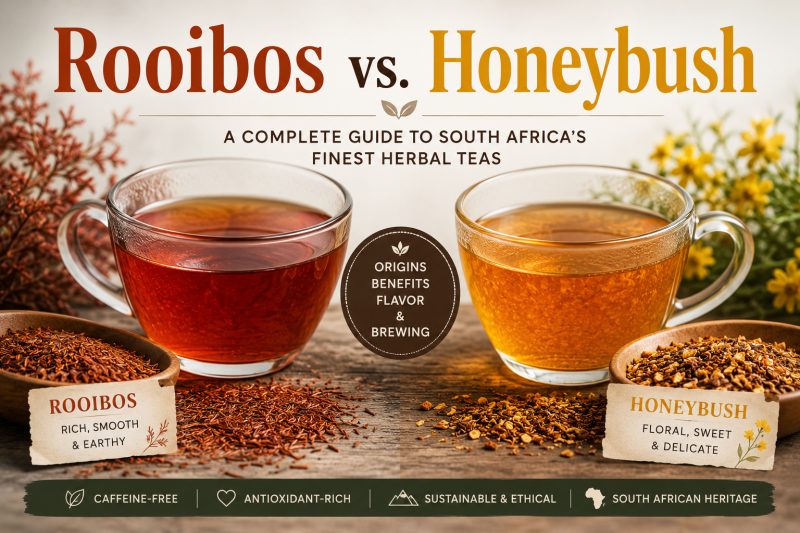
Rooibos vs Honeybush: South Africa’s Finest Herbal Teas Compared
Origins, taste profiles, health benefits, brewing methods, and which one deserves a spot in your cup — fully compared.
By Tea Minded · Updated June 2026 · 8 min read
If you’re exploring caffeine-free herbal teas, two names from South Africa keep rising to the top: rooibos and honeybush. Both hail from the same corner of the world, both are naturally free of caffeine and low in tannins, and both carry centuries of indigenous use. Yet they are distinctly different drinks — in flavor, cultivation, and wellness profile.
In this comprehensive guide, we break down everything you need to know to choose between rooibos and honeybush, or simply appreciate them both.
Quick Navigation
⚑ Key Takeaways
- Rooibos (Aspalathus linearis) grows in the Cederberg Mountains; honeybush (Cyclopia spp.) grows across the Eastern and Western Cape.
- Rooibos tastes earthy, nutty, and lightly vanilla-sweet. Honeybush is sweeter with a floral, honey-like aroma.
- Both are naturally caffeine-free and rich in antioxidants.
- Both brew best at 95–100 °C for 5–7 minutes and can be enjoyed hot or iced.
- Sustainability matters: both crops affect Cape Floral Kingdom biodiversity.
Origins: Where Do Rooibos and Honeybush Come From?
Both teas trace their roots to the Cape Floral Kingdom — one of Earth’s six recognised floral kingdoms and a UNESCO World Heritage site. This tiny sliver of South Africa is home to an extraordinary concentration of plant diversity found nowhere else on the planet.
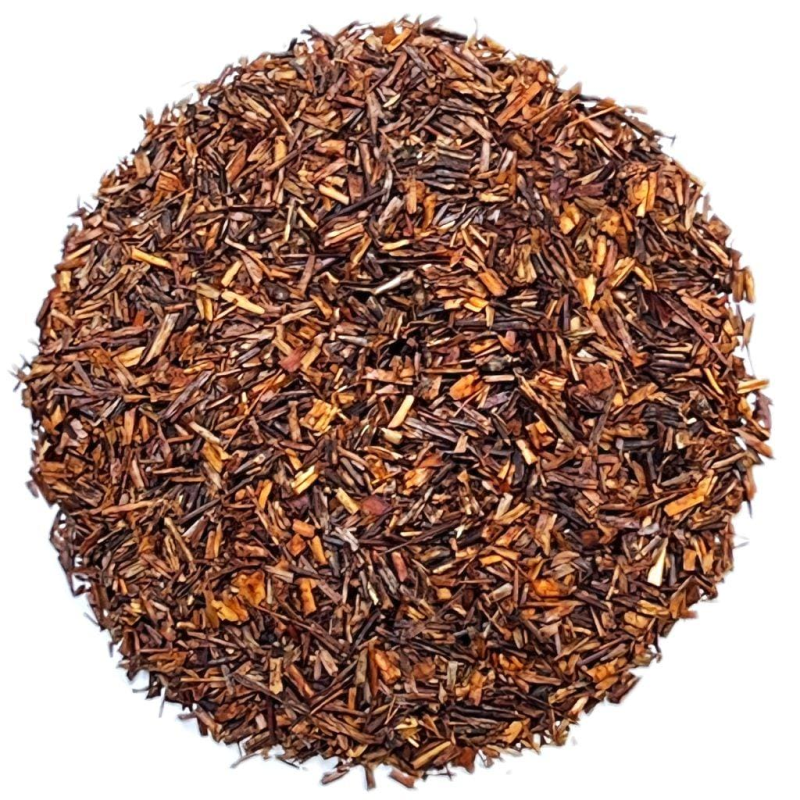
Rooibos (Red Bush Tea)
Rooibos — Afrikaans for “red bush” — is made from Aspalathus linearis, a needle-leafed shrub that grows exclusively in the Cederberg Mountains of the Western Cape. The indigenous Khoisan people gathered and brewed the plant for generations before European settlers took notice. Commercial cultivation began in the early 20th century, largely thanks to Russian immigrant Benjamin Ginsberg, who first exported rooibos to Europe. Today South Africa produces virtually all of the world’s rooibos supply.
Honeybush
Honeybush is made from plants of the Cyclopia genus — specifically their leaves, stems, and flowers. It grows across both the Eastern and Western Cape, with a broader natural range than rooibos. Like rooibos, it was a Khoisan staple before becoming a commercial crop. Honeybush didn’t reach global markets until the 1990s, making it the newer entrant, though it’s gaining rapidly on its more famous cousin.


Rooibos (Aspalathus linearis) — Cederberg Mountains, Western CapeHoneybush (Cyclopia pubescens) — Cape Province, South Africa
Cultivation & Harvesting
Both crops are harvested during the South African summer (January–March), hand-cut and then fermented before sun-drying — a process that develops their characteristic colour and flavour.
| Attribute | Rooibos | Honeybush |
|---|---|---|
| Plant species | Aspalathus linearis | Cyclopia spp. |
| Propagation | Grown from seed | Grown from cuttings |
| Region | Cederberg Mountains, Western Cape | Eastern & Western Cape |
| Harvest season | January – March | January – March |
| Fermentation time | ~12 hours | ~24 hours |
| Water needs | Moderate–high | Lower |
One notable difference: honeybush plants are grown from cuttings taken from mature specimens, whereas rooibos is seeded. Both are ready to harvest roughly 18 months after planting. The longer fermentation period for honeybush contributes to its deeper sweetness.
Taste Profiles: What Do They Actually Taste Like?
This is where the two teas diverge most clearly — and where personal preference will guide your choice.
Rooibos Flavor
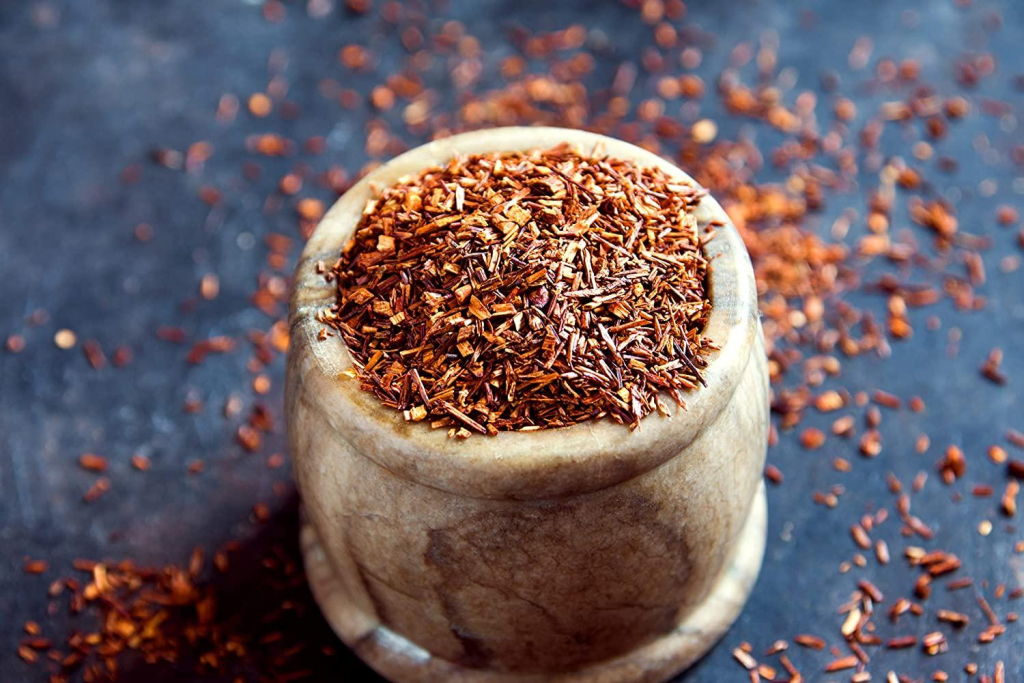
Rooibos delivers a smooth, earthy, and mildly sweet cup with distinct notes of toasted nuts and a subtle vanilla finish. It has a gentle woody quality without any astringency or bitterness. This mellow, round character makes rooibos an outstanding base for rooibos blends and lattes — it holds up beautifully with milk, honey, or spice additions like cinnamon or cardamom.
Honeybush Flavor
Honeybush is noticeably sweeter and more floral. The name isn’t just poetic — there’s a genuine nectar-like quality in the cup, reminiscent of wildflower honey. It’s lighter-bodied than rooibos with a cleaner, almost refreshing finish. Those who find rooibos slightly too earthy often find honeybush an easier gateway.
Health Benefits of Rooibos and Honeybush
Both teas have attracted genuine scientific interest for their bioactive compounds — particularly their polyphenol antioxidants. While research is ongoing and neither tea is a cure-all, here’s what the current evidence suggests.
Rooibos Health Benefits
- Antioxidant-rich: Contains aspalathin and nothofagin, unique antioxidants that combat free-radical damage.
- Heart health: May help lower blood pressure and LDL cholesterol.
- Anti-inflammatory: Polyphenols may reduce systemic inflammation markers.
- Digestive support: Traditionally used to ease colic, cramps, and nausea.
- Calming effect: Caffeine-free nature makes it ideal for evening relaxation.
Honeybush Health Benefits
- Antioxidant-rich: High in mangiferin and hesperidin, powerful anti-inflammatory flavonoids.
- Immune support: Emerging research points to immune-modulating properties.
- Cholesterol management: May help reduce LDL and total cholesterol levels.
- Digestive wellness: Historically used to soothe upset stomachs and improve gut comfort.
- Bone health: Preliminary studies suggest phytoestrogens in honeybush may support bone density.
For a deeper look at how antioxidants in herbal teas benefit your body, the National Institutes of Health research on rooibos polyphenols is an excellent starting point.
How to Brew Rooibos and Honeybush

Both rooibos and honeybush shine when given a full steep — 5 to 7 minutes at near-boiling water.
One of the great joys of these South African teas: they’re practically impossible to over-steep. Unlike green or white teas, they won’t turn bitter even if you forget them for ten minutes.
Brewing Rooibos
- Bring water to a full boil (100 °C / 212 °F).
- Use 1–2 teaspoons of loose rooibos (or one tea bag) per 240 ml cup.
- Pour boiling water directly over the leaves.
- Steep for 5–7 minutes. Longer steeping deepens color and body without bitterness.
- Remove leaves and serve. Add honey, cinnamon, or a splash of oat milk to taste.
Brewing Honeybush
- Heat water to just under boiling (95 °C / 203 °F).
- Use 1–2 teaspoons of loose honeybush (or one tea bag) per 240 ml cup.
- Pour water over the leaves and steep for 5–7 minutes.
- Remove leaves. Honeybush needs no sweetener — its natural honey notes shine on their own.
- Enjoy hot, or refrigerate and serve over ice for a refreshing cold brew.
Want more brewing inspiration? Check out our guide to the best caffeine-free teas and how to brew them for a complete resource.
Environmental Impact
Both teas are grown in the Cape Floristic Region, a UNESCO World Heritage Site and global biodiversity hotspot. This brings both opportunity and responsibility.
Rooibos & the Environment
Rooibos cultivation is water-intensive in a region already stressed by drought. However, it is grown without synthetic pesticides and harvested by hand, supporting local employment. The primary concern is habitat conversion — clearing fynbos scrubland to expand rooibos farmland displaces endemic species.
Honeybush & the Environment
Honeybush requires less water and is naturally pest-resistant, giving it a smaller agronomic footprint. Yet the same habitat-loss risk applies. Responsible sourcing from certified sustainable farms is the best way consumers can support both crops without compromising the remarkable ecosystems that make them possible.
Rooibos vs Honeybush: Quick Comparison
| Category | Rooibos | Honeybush |
|---|---|---|
| Flavor | Earthy, nutty, vanilla-sweet | Sweeter, floral, honey-like |
| Caffeine | None | None |
| Tannins | Very low | Very low |
| Key antioxidants | Aspalathin, nothofagin | Mangiferin, hesperidin |
| Best for | Evening relaxation, lattes, spiced blends | Light drinking, iced tea, solo sipping |
| Brew temp | 100 °C (boiling) | 95 °C |
| Steep time | 5–7 minutes | 5–7 minutes |
| Water footprint | Higher | Lower |
Which Tea Should You Choose?
If you love a warm, comforting, earthy cup that pairs beautifully with milk and spice, reach for rooibos. If you prefer something lighter, naturally sweeter, and floral that needs nothing added, honeybush is your tea. Better yet — stock both. They serve different moods, different moments, and different mornings.

Scott is the founder of TeaMinded. He enjoys tasting and discovering teas from across the globe, with green teas and ceremonial matcha from Japan being among his favorites. He’s grateful to be immersed in the tea community, always learning and sharing along the journey.